 As soon as we reached the town of Burgos, we headed for a café to wait for the
travel agency to re-open after siesta and to drink café con leche to get warm
again. We bought talones and made some reservations for the next 5 nights. The
talones are coupons which you buy from a travel agent for 50 Euros apiece and
allows you to stay in 3 or 4 star hotels for one coupon a night. Normally we
don’t make many reservations when we travel, preferring to go where the mood
strikes us but the talone system is such a good deal that losing a little
flexibility is a small price to pay. (See footnote below for more information on
talones)
As soon as we reached the town of Burgos, we headed for a café to wait for the
travel agency to re-open after siesta and to drink café con leche to get warm
again. We bought talones and made some reservations for the next 5 nights. The
talones are coupons which you buy from a travel agent for 50 Euros apiece and
allows you to stay in 3 or 4 star hotels for one coupon a night. Normally we
don’t make many reservations when we travel, preferring to go where the mood
strikes us but the talone system is such a good deal that losing a little
flexibility is a small price to pay. (See footnote below for more information on
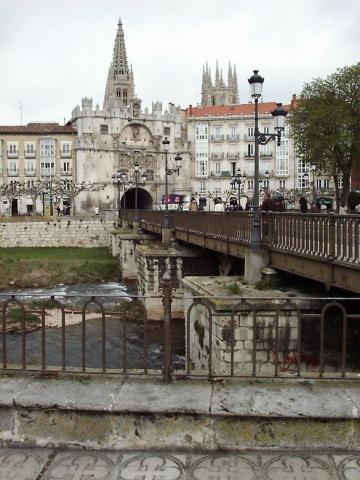
talones)We saw a bit of Burgos while looking for the hotel, that is to say we saw a bit of the same streets as we drove in circles looking for our hotel from the directions the agent gave us. The temperature was dropping from a “balmy” 14C to a distinctly chilly 6C and now it was starting to rain. (it should be noted that 14C is equal to about 57F and 6C equals 43F if I am not mistaken. One thing I am sure of is that it was bloody cold!!) The travel agent had given us instructions on finding the hotel but we were having trouble understanding both her Spanish and the map she drew. Spain is famous for its lisping pronunciations; generally, all C’s and Z’s that should have an S sound to them are pronounced TH. Well, apparently in this area north of Madrid, not only do they speak as fast as a runaway train, they also pronounce the D as TH. The travel agent told us to look for “eltheeth” and everyone else we asked on our search for the hotel also pronounced it the same way. I had no clue what they were talking about, but once we got on the right road, it all came clear - they were referring to a huge statue of El Cid!
We didn’t see much more of Burgos; after reaching the hotel I retreated to the room and took a nice hot bath and didn’t want to go out into the cold wind again. In the morning we took a quick look at the cathedral and ornate portal to the old town. Apparently, Burgos was a major stopping point along the pilgrimage route, offering food and lodging to medieval pilgrims from about 30 different shelters.
 Our next night was spent in Segovia, and the drive the from Burgos was really
pleasant, mostly spent on a 2 lane road through the sparsely populated
countryside. The road took us through rolling hills with rocky fields, pine
trees and scotch broom. Some of the fields are already green with crops and
others are just starting to show the green iridescence of green sprouts against
brick red soil. The road passed through a few ancient villages consisting of old
stone houses, some leaning on each other, others having collapsed years ago; a
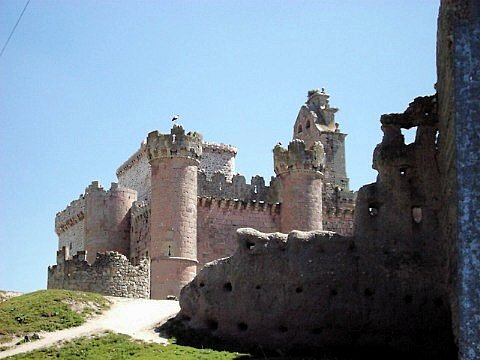
few ruined castles or towers sit on nearby hills. We stopped to explore some
ruins in a town called Turegano, which seemed to be some sort of fortified
church along the road. We had spotted the ruins a ways up the road, noticing
half a dozen large white and black storks lazily circling its towers. The
ruins sat on a breezy hill next to a small town of more ancient stone houses and
I could faintly hear flamenco music coming from one of them. I wish I knew more
about the church, because it was very interesting. It had a high wall all around
so we were not able to enter, with a rather plain church sitting inside its
walls. The towers of the church had lots of large twiggy nests with storks
standing here and there or sitting on a nest
Our next night was spent in Segovia, and the drive the from Burgos was really
pleasant, mostly spent on a 2 lane road through the sparsely populated
countryside. The road took us through rolling hills with rocky fields, pine
trees and scotch broom. Some of the fields are already green with crops and
others are just starting to show the green iridescence of green sprouts against
brick red soil. The road passed through a few ancient villages consisting of old
stone houses, some leaning on each other, others having collapsed years ago; a
few ruined castles or towers sit on nearby hills. We stopped to explore some
ruins in a town called Turegano, which seemed to be some sort of fortified
church along the road. We had spotted the ruins a ways up the road, noticing
half a dozen large white and black storks lazily circling its towers. The
ruins sat on a breezy hill next to a small town of more ancient stone houses and
I could faintly hear flamenco music coming from one of them. I wish I knew more
about the church, because it was very interesting. It had a high wall all around
so we were not able to enter, with a rather plain church sitting inside its
walls. The towers of the church had lots of large twiggy nests with storks
standing here and there or sitting on a nest 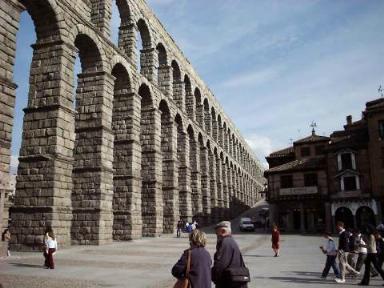 Segovia is an attractive city with a walled old town, some old palacios,
monasteries and churches built in the 12th century, and an impressive roman
aqueduct. Built around the 1st century, the aqueduct is in perfect condition;
the series of free-standing arches are about 28 meters high and run across one
of the main plazas in town.
Segovia is an attractive city with a walled old town, some old palacios,
monasteries and churches built in the 12th century, and an impressive roman
aqueduct. Built around the 1st century, the aqueduct is in perfect condition;
the series of free-standing arches are about 28 meters high and run across one
of the main plazas in town. The next night was spent in the cramped old center of Avila only about 40 miles from Segovia. Our trip there was easy but just as we were nearing the city center, we got hit with a sudden shower of sleet, wouldn’t you know it! Fortunately we quickly found a place to pull under some shelter and wait for it to pass. Our hotel, (for which we paid one talone!) was nearby and easy to find; a renovated palacio conveniently located across from the cathedral. The hotel was very nice and had a large beautiful courtyard with stone arches and coats of arms on the columns, couches and chairs for sitting and drinking coffee or beer. We quickly explored all the sights including the requisite cathedral with stork nests, old buildings and plaza. The old town, set on a hilltop was completely walled as is the norm, but in Avila’s case the wall is still completely intact. Originally built to keep the Moors out, the wall had various portals allowing vehicles and people into the narr
 ow streets. Interestingly, the stones of the
high wall included many that were taken from an old Roman necropolis (cemetery)
that had been found in the area. Some of the roman stones had inscriptions on
them while others were carved as a pedestal for a statue or a niche.
ow streets. Interestingly, the stones of the
high wall included many that were taken from an old Roman necropolis (cemetery)
that had been found in the area. Some of the roman stones had inscriptions on
them while others were carved as a pedestal for a statue or a niche.We discovered a great bar for wine called Bodeguita San Segundo, built into the defensive wall. Inside, the walls of the bar held shelves and racks filled with wine bottles from all over Spain. On the bar itself, groups of wines arranged by region and color were available for buying by the glass. Each glass of wine was accompanied by a small plate of tapas; a few pieces of cheese on bread, or perhaps some calamari or cured ham. When we got the bill, we thought there had been a mistake; 5 glasses of wine and a large plate of cheese came to around 25 Euros. The waiter said, well, you had 5 glasses of wine and.. "No, no", I said, "We thought the price was not high enough to be correct"...
 Next Page