April 16th, 2003
When we left Avila, we finally descended the high plains we had been on since
Burgos and once we had crossed a couple of 3-4000 ft passes on a 2 lane country
road, we were soon winding our way down the mountains into a fertile garden-like
area. It had rained maybe an hour before we passed and the road was just drying,
but the air was fragrant with the earthy smell of wet green plants and damp
earth as well as the smell of the abundant
Spanish lavender growing alongside the road.
The wildness of the Spanish countryside slowly
gave way to cultivated fields and groves of trees; olive
groves interspersed with fields of grain. As we descended, the road crossed an
old Roman road, zig-zagging down the hillside on a path of its own. Built of
stone, the roman road was broad enough for two lanes of traffic and was in such
good condition that it appeared as if it had only been abandoned from use a few
years ago. Called the Ruta de la Plata, the route of silver, the road once ran
from just north of Sevilla all the way to the Northern coast of Spain. Today,
most of the road has been obscured by the modern road which follows the route of
the old roman road. Too soon we hit the highway and picked up speed. The air was
balmy but we were riding towards an ominous bank of clouds that just kept
getting blacker; suddenly we were hit with some terrific side winds and the
temperature dropped about ten degrees. When it finally started raining, it came
down in sheets so we ducked under a nearby hotel’s covered parking and had a cup
of coffee at the bar to wait out the rain. Luckily we weren’t too far from our
next hotel for the night, in Merida.
We had been in Merida before and enjoyed it very much. It started out as a roman
model city in 25 B.C. called Augustus Emeritus which was built to house roman
military veterans and also to impress the local Spanish peasants. There are many
ruins to see and a beautiful museum housing some very nice mosaic floors but
unfortunately by the time we got to the museum it had just closed and wouldn’t
open again for a couple of days. The weather was very different from our last
visit, also; instead of hot sunny weather, we had cold wind and rain.
We still have three days to kill but little motivation to stay in Merida longer,
the grey gloomy weather and cold wind was not encouraging and it was a bit of a
hike from our hotel to get to the 1 kilometer long roman bridge that we had to
cross to get into town. We decided to go to a town called Zafra the next day,
partly because we liked the name of it and partly because it was on the road to
Sevilla.
Zafra is a charming small town with few tourists; inhabited through history by a
succession of peoples – Romans, Moors, Visigoths an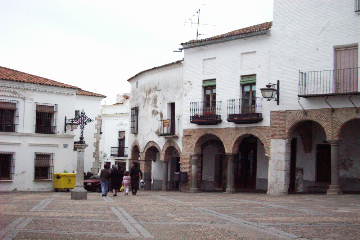 d
Spanish, all leaving their unique stamp on the town. We checked around and found
a two star hotel for €29 a night with a room that wasn’t fancy but was close
to the main square, a pretty plaza ringed with arched arcades and palm trees
around a round fountain. The hotel was grandly called Hotel Don Quijote and the
proprietor a cheerful round man with a resemblance to Sancho Panza. Townspeople
strolling across the plaza headed for the pedestrian shopping street leading off
one side of the plaza for their evening walk. Among them were a trio of brown
habited nuns with rope belts and white wimples looking as if they had just
stepped out of a painting from the middle ages.
d
Spanish, all leaving their unique stamp on the town. We checked around and found
a two star hotel for €29 a night with a room that wasn’t fancy but was close
to the main square, a pretty plaza ringed with arched arcades and palm trees
around a round fountain. The hotel was grandly called Hotel Don Quijote and the
proprietor a cheerful round man with a resemblance to Sancho Panza. Townspeople
strolling across the plaza headed for the pedestrian shopping street leading off
one side of the plaza for their evening walk. Among them were a trio of brown
habited nuns with rope belts and white wimples looking as if they had just
stepped out of a painting from the middle ages.
Sitting in the bar of our hotel having breakfast one morning, Mike struck up a
conversation with an older couple. They turned out to be from Holland and were
pilgrims, this year intending to walk from Sevilla to Salamanca, some 295 miles
in the space of 2 or 3 weeks. They have been making a pilgrimage for years and
apparently do it in stages, each year walking a different section of the trail.
The modern pilgrimage trail is not much different from the “old” days, being a
trail marked with yellow arrows that passes through towns along the way where a
pilgrim can find food and lodging.
A small fortified castle called the Alcazar is one of the most interesting
buildings in Zafra with 8 round turrets with crenellated tops and a large square
open-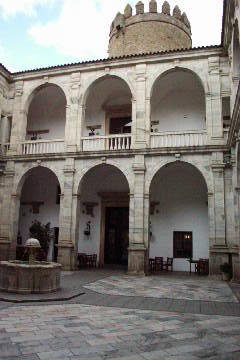 air courtyard
inside. The Alcazar has been restored and is now a special type of Spanish hotel
called a Parador where you can spend a luxurious night in restored historical
buildings such as medieval castles, forts, convents and monasteries or antique
palaces starting at about $100 per night. They can be found all over Spain and
many can be paid for on the talone system. We have tried a few times to reserve
a night in one but rooms can be difficult to come by at this time of year.
air courtyard
inside. The Alcazar has been restored and is now a special type of Spanish hotel
called a Parador where you can spend a luxurious night in restored historical
buildings such as medieval castles, forts, convents and monasteries or antique
palaces starting at about $100 per night. They can be found all over Spain and
many can be paid for on the talone system. We have tried a few times to reserve
a night in one but rooms can be difficult to come by at this time of year.
Our first night in Zafra coincided with the second night of Semana Santa (holy
week). Sitting in a tapas bar having something to eat, I heard the strains of
some very eerie music slowly getting louder so I went out to see what was going
on. At the corner of the street were a collection of damp spectators with
umbrellas unfurled against the sprinkles coming from the sky watching a
candlelit procession. The penitents in their pointy Ku Klux Klan headgear had
just passed carrying fat three foot long candles; long white robes, red capes
and hoods covering the face make them look anonymous and sinister. One of the
first pasos of the week was laboriously edging its way around the corner,
followed by a band of cornets and drums playing a wavery mournful sound,
beautiful and dire at the same time. The paso, a sort of parade float about the
size (and weight) of a small car, is carried on the backs of about 30 or 40 men
concealed underneath. The procession moves agonizingly slowly as the float has
to be set down every 10 minutes or so to let the carriers rest, then on a signal
the float is heaved into the air with a grunt and slowly sets off down the
street again. The float was made of richly carved and gleaming wood and the top
was covered with a carpet of red carnations and purple iris with large
candelabras at each corner with fat white candles. The sole wooden figure of
Jesus stood in the center, almost life sized, hands bound with a golden rope.
His white velvet robe was simply embroidered in gold thread at the hem and three
golden rays emanated from his head, signifying the trinity. Because of the rain,
Jesus was unfortunately wearing a plastic bag from head to toe to keep him from
getting wet, somewhat diminishing the impact! The floats usually weigh a ton or
more, and the slow steps of the men underneath it cause the float to sway down
the street from side to side in kind of a trudging manner giving the illusion
that Jesus was slowly and painfully walking to his doom. Even I have to admit,
that although I am not a religious person, I found it hard to not be moved by
the spectacle.
After the Paso of Jesus and his attendants came the Paso of a mournful Mary,
standing weeping behind a bank of long white candles and white roses, under a
canopy richly embroidered with precious gems and metal threads, gold tassels and
golden lace. Her progress was perfumed by clouds of burning incense and was
accompanied by her own entourage of penitents and marching band. As the paso
moved down the street the canopy covering it would sway from side to side almost
touching the walls of the buildings on either side of the narrow streets.
Holy week is taken very seriously by the Spanish but nowhere as fervently as in
Sevilla where the series of processions that loop through the town, leaving the
home church, pass through the great doors of the cathedral and back out again to
head back home again, sometimes 8 or 9 hours later. This year however, the rain
prevented many of the pasos from leaving home; images on the TV showed shocked
and sodden penitents sobbing with disappointment in the pouring rain.
After two nights in Zafra, we were ready to move on. We still had one night to
kill so we headed towards the southern coast of Portugal through pine and
eucalyptus forests and fields of grain, fields with sprouts of sunflowers
already 2 or 3 inches high. The sun was shining which was a wonderful change,
and as we moved a little further south and west, we started riding through vast
orchards of olives and orange trees, the scent of orange blossoms filling the
air; so strong and sweet smelling at times you could almost taste it. By
afternoon, we were in a small town called Tavira where we got a room in a new
hotel with a view of the town and a sliver of ocean. For the first time during
our trip through Spain, we finally were able to enjoy a day with sun! Judging
from the sunburned skin of the tourists in town, we weren’t the only ones ha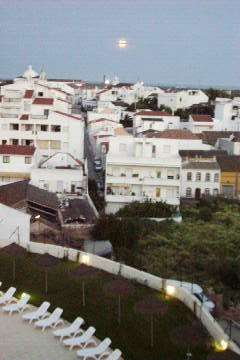 ppy
to see it.
ppy
to see it.
Tavira, like most
typical Portuguese towns, from a distance appeared tidy and blindingly white but
close up you notice that the front facades of the buildings have been covered
with patterned tiles like fancy wallpaper. We took a walk through town at
twilight, and the air was still warm and softly scented with the orange blossoms
of the orchards a few miles away. The river running through the town was lined
with restaurants selling fresh fish and sea food, where we stopped to have a
drink at one of the tables on the sidewalk.
For the first time after leaving Paris, we were able to find a self-service
laundry in Tavira where we could finally wash our clothes. Self service
laundries are hard to find in Spain so travelers are forced to either have their
hotel wash their clothing or else take dirty clothes to a local dry-cleaners to
have them washed. But for people who are traveling on a long term basis this
gets a little expensive and while washing clothing by hand in the bathroom sink
may be ok for socks and undies, shirts and jeans just don’t get very clean. So
you can imagine we were very happy to be able to change clothes into something
freshly laundered. We chatted for a while with the proprietor of the laundry, a
Frenchman from Paris who finds the life in Tavira to be much more to his liking;
calm, cheap and with nice sunny weather. He told us where to find a good
supermarket and recommended a decent local wine that costs only €1.99. (!) We
had a simple dinner of local Portuguese cheese, bread and wine, an apple and
some almonds while we watched the moon set, hanging over the sea huge and rosy
orange like a peach.
Footnotes:
The Hotel Don Quijote can be found at 3, Calle Huelva in
Zafra, Spain. Telephone- 924 55 47 71, fax 924 55 47 82. It is a 2 star hotel
with its own bar and restaurant. The rooms have their own bath, TV, and
telephone for around €30 a night double occupancy. Not fancy, not including
breakfast, but clean and close to main square.
Previous Page
 Next Page