July 29, 2003
 After
our usual breakfast at the bakery, we headed north up the coast as Stefan
suggested. There were some interesting things to see within a days’ ride from
Kungshamn, so I wish we had known about them earlier, but I guess that’s what we
get for not carrying guide books with us when we travel. We stumble on a lot of
cool stuff quite by accident while passing up a lot of tourist stuff both
knowingly and unknowingly. It was a beautiful day for riding and lots of bikes
were out on the road, nearly each rider greeting us with a wave as they drove
past.
After
our usual breakfast at the bakery, we headed north up the coast as Stefan
suggested. There were some interesting things to see within a days’ ride from
Kungshamn, so I wish we had known about them earlier, but I guess that’s what we
get for not carrying guide books with us when we travel. We stumble on a lot of
cool stuff quite by accident while passing up a lot of tourist stuff both
knowingly and unknowingly. It was a beautiful day for riding and lots of bikes
were out on the road, nearly each rider greeting us with a wave as they drove
past.
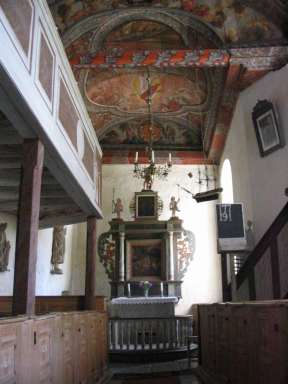
The first stop was the Svenneby
church which several people said was a must-see. It was a small, plain stone
building built in the early part of the 12th century, and its belfry
sat by itself on the cliff above which seems to be typical of the older Swedish
churches. Inside the church, we found it charming; a space with lots of light
streaming in through large clear windows, with narrow wooden pews closed off by
gates, several wooden statues of Jesus and some assorted saints from the middle
ages, and a loft hanging low above our heads. In the old days, the women would
sit on one side of aisle while the men sat on the other; I could imagine them
sitting there in their lacy caps and aprons. The wooden boards of the ceiling
and altar were painted with biblical scenes and date from the 18th
century, and the red and blue swirls of paint gave it a folk art feeling.
Just up the road, we found a
Viking village, which seemed to be in the process of being built. People dressed
in homespun garments and using hand tools were busy reconstructing buildings and
workshops after archeological research and demonstrating Viking crafts like
felt-making and wood carving to the visiting children. One interesting building,
a longhouse, had a roof shaped like an overturned boat, its bowed supporting
beams braced against the ground to give it strength. Here the tribe would gather
and spend a lot of their time using the longhouse as a communal living room.
Another curious building looked like a haystack, with a small round opening and
an earth floor.
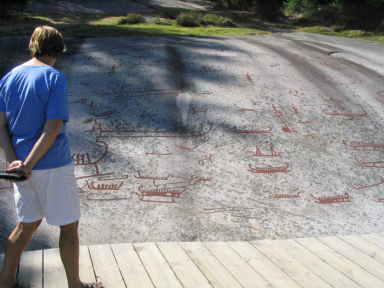 The
area has had inhabitants even further back than the Vikings; 3 thousand years
ago, people lived here and left their mark in the stones in the form of
rock carvings and built dolmens - chambered graves of stone. We stopped briefly
at a grave field that contains about 200 graves from a later period,
approximately 200-400 A.D., with both standing stones and barrows. The area
around Tanum is particularly rich with rock carvings from between 1800 and 500
B.C. and at Vitlyke, there is an interpretive museum and walking paths that lead
you through to some of the finest examples to be found. Scientists studying the
carvings have painted the carved figures with red paint to make it easier to
see. Many of the carvings are of long boats - at least 10,000 of them - with
lines representing the crew, while others are comical stick people wielding long
spears and shields. Some animals are depicted, including a whale, and symbols
representing the sun, footprints and round “cup marks” which would hold
offerings to the gods. I could have spend days there but it was afternoon
already, and we hadn’t gone very far.
The
area has had inhabitants even further back than the Vikings; 3 thousand years
ago, people lived here and left their mark in the stones in the form of
rock carvings and built dolmens - chambered graves of stone. We stopped briefly
at a grave field that contains about 200 graves from a later period,
approximately 200-400 A.D., with both standing stones and barrows. The area
around Tanum is particularly rich with rock carvings from between 1800 and 500
B.C. and at Vitlyke, there is an interpretive museum and walking paths that lead
you through to some of the finest examples to be found. Scientists studying the
carvings have painted the carved figures with red paint to make it easier to
see. Many of the carvings are of long boats - at least 10,000 of them - with
lines representing the crew, while others are comical stick people wielding long
spears and shields. Some animals are depicted, including a whale, and symbols
representing the sun, footprints and round “cup marks” which would hold
offerings to the gods. I could have spend days there but it was afternoon
already, and we hadn’t gone very far.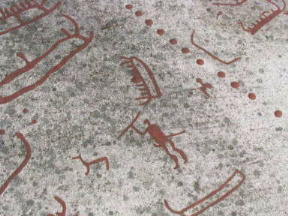
Up the coast a little further,
and we started seeing a few large shopping centers and factory outlet stores in
the middle of nowhere. We were getting close to the border with Norway, and as
every one kept telling us, everything is a lot more expensive in Norway. We saw
lots of cars with Norwegian plates and stores full of shoppers, so I guess it’s
true. We crossed the border into a sparsely populated corner of Norway and over
a bridge with a spectacular view, past cameras set every few kilometers scanning
the traffic hoping to catch speeders and take their pictures. Not too much
further and we had passed the small town of Halder and turned east where we
crossed the border back into Sweden.
Time to find a room for the
night. We found ourselves in a small town called Ǻrjäng, in front of the tourist
information office. The young lady working there helped us find a Bed and
Breakfast for around €50. We checked ourselves in, had a nice chat with the
woman running the B&B then went out to walk around the town. She had told us she
hoped it would be quiet tonight and paused a moment, calculating. Yes, it’s
Wednesday, it should be alright. We were gradually realizing that this was not
your typical Swedish town; noisy 2-stroke dirt bikes and cars with rap music
booming out of huge American-style speakers trolled up and down the street. A
raucous group of teenaged boys hung around at the main square. A young woman
stood in front of a closed gas station on a deserted street looking like she was
for hire; when I turned around to look again, she was gone. We went back to the
tourist information to ask some questions and the girl also told us that since
it was Wednesday, it wasn’t too bad – on Fridays, Saturdays and Sundays, the
streets can be noisy all night long with the cars and bikes, and strolling
teenagers out at night with nothing much to do…Every one we talked to seemed to
agree on one thing: that it was a nuisance, but with a helpless shrug of their
shoulders said there was nothing much that could be done. This town apparently
doesn’t have a full time police force. A few days later, I was talking to a
Swedish biker and told him of our experience and he laughed and said, “yes,
Ǻrjäng has that reputation. The Swedes say it is a place outside the law.” He
went on to explain that it was a portal for drugs coming from Norway into
Sweden…
The next morning we headed to
Lake Siljan on a 2 lane highway through the pine and birch forests. We got a
very nice room in a hotel set in a tranquil park in a town called Mora. We were
now in the Dalarna province which is famous for the carved wooden horses,
painted red with a garland of folk flowers around their necks. Dalarna is also
famous for all of its other folk crafts and as we traveled through the area we
passed fields of flax for making linen, weaving studios, pottery studios, wooden
horse workshops and handcraft guild stores where one can buy the local
traditional costume of the area or the materials and patterns to make your own.
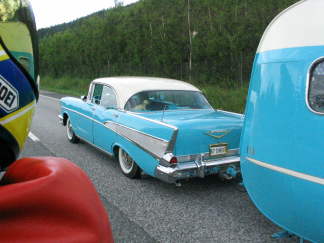 Following the east coast of Lake
Siljan, we made a stop in Rättvik where a classic car rally was in progress.
Thousands of old American cars were in town; almost all lovingly detailed and in
pristine condition. These classic beauties were on the road all through the
area, classic American rock music wafting through the rolled-down windows.
Activities like a drive-in movie and a sock hop were also planned for the
evening program. Mike and I strolled through the parking lot, admiring cars he
hadn’t seen in decades. Convertibles and Cadillacs and tail fins are favorites
but we also saw Hudsons, Edsels and the like, not to mention some later classics
like Mustangs and Corvettes. Some of them were pulling vintage-looking trailers,
carefully detailed and painted in the same colors as the car.
Following the east coast of Lake
Siljan, we made a stop in Rättvik where a classic car rally was in progress.
Thousands of old American cars were in town; almost all lovingly detailed and in
pristine condition. These classic beauties were on the road all through the
area, classic American rock music wafting through the rolled-down windows.
Activities like a drive-in movie and a sock hop were also planned for the
evening program. Mike and I strolled through the parking lot, admiring cars he
hadn’t seen in decades. Convertibles and Cadillacs and tail fins are favorites
but we also saw Hudsons, Edsels and the like, not to mention some later classics
like Mustangs and Corvettes. Some of them were pulling vintage-looking trailers,
carefully detailed and painted in the same colors as the car.
We also passed a motorcycle
boutique sitting by itself along the highway, so we turned around to check it
out. About a dozen bikes sat outside, helmets and leather jackets left sitting
on the bikes as the owners shopped inside. We have observed this all over
Sweden, people are always telling us how safe it is in this country. I chatted
with a talkative guy who works in the shop about our travels and the tours he
leads in Norway.
The next morning we woke up to
clouds and pouring rain but we packed anyway, and hung out at the hotel waiting
for the rain to pass (watching the animated movie “Ice Age” in Swedish) and by
1:30, the rain had tapered off and we were able to leave. We found a roadside
pension where we got some coffee and freshly made heart-shaped waffles topped
with strawberries and a huge dollop of unsweetened whipped cream.
Traveling south, and
backtracking towards the west coast, we wound up back in Gothenborg at the
floating Ibis Hotel. We headed to the avenue to get something for dinner where
we ran into a group of Spanish minstrels from Granada (Tunas), holding their
mandolins and dressed in capes and black velvet, looking a bit lost. We stopped
and talked to them and they explained that they were looking for a place to
play. They had asked at some of the restaurants lining the sidewalks if they
could play there but were told no, so they were at a loss as to what to do. We
chatted a bit about Spain and Sweden then left to eat, telling them that they
should just set up and play on the corner. Walking back towards the hotel after
dinner, we didn’t see them again, but we did see a few other sidewalk
“musicians” such as the pair with keyboards and guitar and portable amplifier,
or the pudgy guy with the thick glasses and a microphone into which he “sang”
off-key along with the music coming from the boom box slung around his neck
 From
Gothenborg, we headed back into Europe; over the bridge to Copenhagen. It was
still early and Mike thought it would be fun to go see the little mermaid so we
made a whirlwind tour through Copenhagen, following the signs to the city
center. At a large intersection, we stopped for a red light in front of a
tourist information center so I ran inside and grabbed a map, then enlisted a
taxi driver to show me on the map where we were and where we needed to go. We
followed the map and the driver's directions past Tivoli gardens (the oldest
amusement park in Europe?), past lots of cool old buildings with copper roofs
(ooh, cool, did you see that one?!), and past an old castle hidden behind a
large dike, finally ending up at the harbor. We could see the water of the
harbor but no mermaid, so we asked someone who told us, “she’s that way, just a
few hundred meters. She’s small but you can tell where she is by looking for the
group of Japanese taking pictures”.
From
Gothenborg, we headed back into Europe; over the bridge to Copenhagen. It was
still early and Mike thought it would be fun to go see the little mermaid so we
made a whirlwind tour through Copenhagen, following the signs to the city
center. At a large intersection, we stopped for a red light in front of a
tourist information center so I ran inside and grabbed a map, then enlisted a
taxi driver to show me on the map where we were and where we needed to go. We
followed the map and the driver's directions past Tivoli gardens (the oldest
amusement park in Europe?), past lots of cool old buildings with copper roofs
(ooh, cool, did you see that one?!), and past an old castle hidden behind a
large dike, finally ending up at the harbor. We could see the water of the
harbor but no mermaid, so we asked someone who told us, “she’s that way, just a
few hundred meters. She’s small but you can tell where she is by looking for the
group of Japanese taking pictures”.
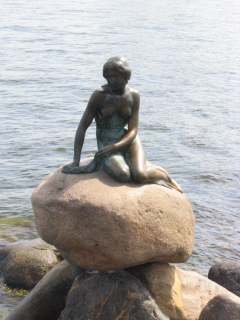
She was indeed small, about 4
feet tall, sitting by herself on a outcropping of rock just off the embankment
in the water. A couple of Spanish tourists clowned around for the camera, and as
soon as they were done, I took my requisite shots and then we left to make our
way out of Copenhagen and on the road to Germany.
Previous Page
 Next Page