July 27th, 2003
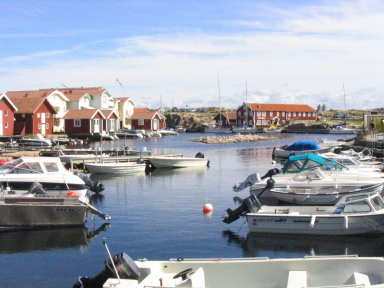 Kungshamn (meaning
King's Harbor in Swedish) turned out to be an interesting place with a distinct
little-beach-town feel to it. It was a relaxing place to hang around, and I
needed to do some writing so it worked out well for me. We also strolled around
enjoying the beautiful weather and the charming town. Clusters of typical little
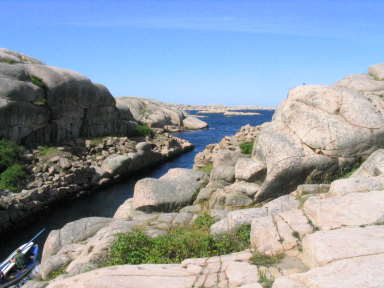
wooden houses are set amongst smooth granite rock formations, with almost no
trees to be seen. During the winter it is a small fishing village of a few
thousand people but in recent years it has become a popular tourist destination
during the short summer months, when it swells to about eight times its normal
size. There is one hotel, reserved months ahead of time, that charges €300 per
night. Luckily there are other options. Many choose to camp nearby (again, for
way too much money) while others if they are lucky find a room to rent in a
private house. Stefan had found us a room with Lennart, an old friend, who had
probably the last available room in town. It was a small single room with a sink
and stove, a table and some chairs and a bunk bed. A toilet and a communal
refrigerator in the hall, which we soon filled with pear cider. The shower was
around the back of the house through the soggy yard. Wait a minute, bunk beds?!?
Not likely. We pulled the foam mattresses off the beds and made our bed on the
floor, which just barely fit in our tiny room. This palace cost us the paltry
sum of 600 Kronas a night. That translates to about €70 per night! (I thought
someone had told us Sweden was cheap but I must have been dreaming).
Kungshamn (meaning
King's Harbor in Swedish) turned out to be an interesting place with a distinct
little-beach-town feel to it. It was a relaxing place to hang around, and I
needed to do some writing so it worked out well for me. We also strolled around
enjoying the beautiful weather and the charming town. Clusters of typical little
wooden houses are set amongst smooth granite rock formations, with almost no
trees to be seen. During the winter it is a small fishing village of a few
thousand people but in recent years it has become a popular tourist destination
during the short summer months, when it swells to about eight times its normal
size. There is one hotel, reserved months ahead of time, that charges €300 per
night. Luckily there are other options. Many choose to camp nearby (again, for
way too much money) while others if they are lucky find a room to rent in a
private house. Stefan had found us a room with Lennart, an old friend, who had
probably the last available room in town. It was a small single room with a sink
and stove, a table and some chairs and a bunk bed. A toilet and a communal
refrigerator in the hall, which we soon filled with pear cider. The shower was
around the back of the house through the soggy yard. Wait a minute, bunk beds?!?
Not likely. We pulled the foam mattresses off the beds and made our bed on the
floor, which just barely fit in our tiny room. This palace cost us the paltry
sum of 600 Kronas a night. That translates to about €70 per night! (I thought
someone had told us Sweden was cheap but I must have been dreaming).
The next morning was a bright sunny day with brilliant blue
sky. No sign of the previous days’ downpour except for the soggy lawn. Our
leathers, boots and even the insides of the helmets up to the ears were still
damp, even after a spell in the drying room so we spread everything out outside
to dry. Water had even gotten into the side bag and some of my clothes were
dampened by the three hour ride through the rain. I hung them up as well, then
we walked down to the bakery to find something for breakfast. We found a nice
assortment of stuff from seeded rolls and sandwiches (called Smorgasar - which
the Swedish eat for breakfast) to sweets like Swedish-style cinnamon rolls –
unfrosted but sprinkled with little bits of coarse sugar. Not nearly as sweet as
the American variety. The pistachio rolls were tempting, like the cinnamon rolls
but with a greenish pistachio paste inside and cardamom and they taste heavenly!
We got some lattes and some goodies to eat and took them into the sun while we
had breakfast.
After breakfast we ran into Stefan on an errand to pick up
some stuff at the grocery. Since there are so many tourists in town the lines at
the grocery stores get a little long, forcing locals to go very early or very
late if they want to avoid long waits. Lines formed quickly at the ATM machines,
too, but otherwise the downtown area was pretty quiet, with a car passing us
every few minutes. Stefan laughed as he told us his mother had complained about
all the traffic in the town – obviously she’s not spent much time in a city like
Paris (for example)! He also said he had talked to his brother about our
motorcycle battery; he was able to buy one for us in Gothenburg and would be
here in Kungshamn the next day.
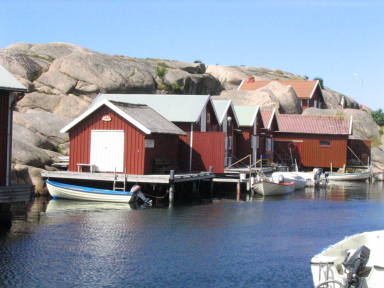 After
Stefan’s errands were done, he suggested we go explore Smögen, a picturesque
island across the harbor. He took us over the bridge to Smögen and dropped us
off, explaining that we could catch a taxi boat back to downtown Kungshamn.
After
Stefan’s errands were done, he suggested we go explore Smögen, a picturesque
island across the harbor. He took us over the bridge to Smögen and dropped us
off, explaining that we could catch a taxi boat back to downtown Kungshamn.
Smögen boasts a long wooden boardwalk, suspended out over the
water of the harbor. The island is one big, rounded lump of granite and today,
in the sun, it is glowing a warm pink color, bits of mica in the rock sparkle as
the sun hits it. Cottages turned into stores hug the rocks along the boardwalks,
and tellingly, most of the stores sells scarves and foul weather gear as well as
Swedish clogs and nicknacks. Tourists were plentiful, looking at clothing shops,
eating at one of the many small food stands selling Swedish hot dogs and ice
cream or watching the boats go by. Some local boat owners were taking advantage
of the beautiful day to bail water out from yesterday’s rain and to hang wet
clothing on lines and rigging and any available space where they could catch the
sun. I leaned out over the rail to look into the water of the harbor and was
amazed to see lots of floating things in the water; ghostly blue jellyfish,
almost translucent and the size of your fist, propelling themselves slowly
through the water. There were also larger yellow and red jellyfish, with long
trailing tentacles several feet long. These jellyfish are larger than the blue
and are capable of giving a swimmer a painful sting. The yellow and red
jellyfish fish have a strange, barely cohesive look to them, like bread slowly
disintegrating in water. We wandered all the way to the end of the boardwalk
past the boathouses, then headed back to where the taxi boat was waiting to take
its load of passengers to Kungshamn for about €2 each.
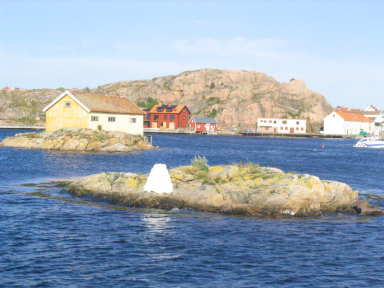 There is an
archipelago of islands surrounding Kungshamn; although not as extensive as the
one near Stockholm, it has proven more deadly to the fisherman navigating them
in their small boats. Some of the islands are covered by water during high tide
and the only sign of them is to watch how the waves crash on the unseen object,
sending spray high into the air. The islands have caught many sailors unaware
and for this reason, Kungshamn was originally named Gravarne, which means “the
graves”. The whole area is really quite beautiful; the landscape is very
simplistic and restful; sky and water and rocks. Stefan came to pick us up at 4
p.m. for the boat ride he had been telling us about.
There is an
archipelago of islands surrounding Kungshamn; although not as extensive as the
one near Stockholm, it has proven more deadly to the fisherman navigating them
in their small boats. Some of the islands are covered by water during high tide
and the only sign of them is to watch how the waves crash on the unseen object,
sending spray high into the air. The islands have caught many sailors unaware
and for this reason, Kungshamn was originally named Gravarne, which means “the
graves”. The whole area is really quite beautiful; the landscape is very
simplistic and restful; sky and water and rocks. Stefan came to pick us up at 4
p.m. for the boat ride he had been telling us about.
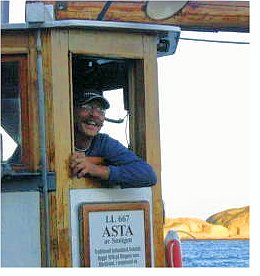
Assembling at Stefan’s friends’ house, about a dozen of us
walked down to the harbor where we were greeted by the captain of a traditional
fishing boat, built in 1916. The captain, a cheerful man with round glasses and
a luxurious moustache that curled at the ends, gave us a running commentary (in
English) as we steamed out of the harbor. We headed into a canal that was dug by
hand many years ago to facilitate the fishing boats passage to the sea and ate a
picnic of crayfish and bread. We passed farmland and more rocks – lots of rocks,
carved into projecting rock formations, deep clefts and fantastic pot-holes –
and a curious little one-room cottage made out of stone with a
 grassy sod roof, built a
century ago to house a poor family with 7 children. It is hard to imagine how
poor the people living here were in those days. Mike and I sat near the center
of the boat, wearing our rain jackets against the wind, and I was glad we had
brought them, because once out of the canal, we headed out into the North Sea.
The boat began to buck and pitch, the front of the boat rising high into the air
before slamming down on the rough water sending cascades of water over the sides
and down on our heads! Soon (thank god!) we turned back and headed back to the
harbor. Slightly green in the face, I was the first one off the boat. An
exciting finish to our boat ride, and we were soaked from head to toe again, for
the second day in a row!
grassy sod roof, built a
century ago to house a poor family with 7 children. It is hard to imagine how
poor the people living here were in those days. Mike and I sat near the center
of the boat, wearing our rain jackets against the wind, and I was glad we had
brought them, because once out of the canal, we headed out into the North Sea.
The boat began to buck and pitch, the front of the boat rising high into the air
before slamming down on the rough water sending cascades of water over the sides
and down on our heads! Soon (thank god!) we turned back and headed back to the
harbor. Slightly green in the face, I was the first one off the boat. An
exciting finish to our boat ride, and we were soaked from head to toe again, for
the second day in a row!
We had coffee with Lennart, our host, and chatted while Mike
tried to fix his computer problems (to no avail). We were wondering why, with
all the granite around, all the houses were built out of wood. Lennart told us
that the stone houses are cold (I can believe that!) and hard to insulate, but
even more importantly, there is radon in the rock. The people who have lived
here all their lives have a high incidence of cancer. Winters here can be quite
cold, but in summer it is mild and pleasant and the sea gets “nice and warm”,
maybe 71 or 2 degrees Fahrenheit. Lennarts’ wife told us that she had gone to
one of the islands to swim in the sea and there were so many of the little blue
(non-stinging) jellyfish, that it was like ”swimming in noodle soup”.
 Life
here a hundred years ago was quite difficult and many people were starving. But
they did have one important resource, which was all around them: the granite
rocks. The granite was such good quality that by the end of the 19th century, it
was popular for both building and roads. Stone quarries became the dominant
industry and the main source of income for the locals. The height of the stone
quarries came just prior to the turn of the last century but declined after new
building materials were taken into use and asphalted roads replaced
cobblestones. These days they depend on 2 or 3 months’ worth of tourist money.
This would explain why the town is deserted most of the year, only coming to
life in the all-too-brief summer.
Life
here a hundred years ago was quite difficult and many people were starving. But
they did have one important resource, which was all around them: the granite
rocks. The granite was such good quality that by the end of the 19th century, it
was popular for both building and roads. Stone quarries became the dominant
industry and the main source of income for the locals. The height of the stone
quarries came just prior to the turn of the last century but declined after new
building materials were taken into use and asphalted roads replaced
cobblestones. These days they depend on 2 or 3 months’ worth of tourist money.
This would explain why the town is deserted most of the year, only coming to
life in the all-too-brief summer.
On our last day in Kungshamn, Stefan came by with a new
battery for our bike and helped install it. Stefan and Jennifer had planned to
continue their trip with a couple of friends by spending about 5 days riding in
Norway and we agonized over whether or not to go along. The main problem was the
weather; the forecast for Norway was one day of sun then five days of rain. The
countryside is supposed to be spectacular and the roads twisty, thanks to the
mountains, but it is the mountains that attract the rain clouds that typically
keep the area damp. They would be staying in small cabins along the way, and
sleeping in sleeping bags; they had scrounged up some bags but were still
missing one if we decided to go. We had finally gotten everything dried out
after a few days in the sun and we weren’t anxious to head into more rain so
with deep regret we decided not to go. I know, we sound like wimps but if we
could get that wet after three hours of downpour, I could just imagine what it
would be like trying to dry clothes every night in an unheated cabin…
Stefan gave us some suggestions for a route we could take then
we said our goodbyes before he left to prepare for their departure early the
next morning. Meanwhile, it was now late afternoon and we started thinking of
what to do for our last dinner in Kungshamn. Remembering the picnic on the boat
the day before, Mike suggested we get some more crayfish. That sounded like a
good idea so we strolled down to the harbor and took the taxi boat, which had
just arrived, to the harbor in Smögen. Once there we walked past several stands
selling lottery tickets for a bucket of shrimp, then we saw a good sized store
with seafood in glass cases so we went in. The store was busy with shoppers
buying various types of fish, fresh lobsters, shrimp and crayfish. Another glass
case held trays of hot loaves of garlic bread and buckets on ice full of various
types of salads: potato, cabbage, shrimp. We bought a big bag, about a kilo,
full of large boiled crayfish, ready to eat . Some garlic mayonnaise, and some
hot garlic bread which smelled so good half of it was gone by the time we
arrived home. All this for about 30 euros.
Previous Page
 Next Page