August 30th, 2003
Winding down out of the Pyrenees, we headed back into Spain
where we stopped for a quick lunch in the Catalan town of Seu d’Urgell. The town
was preparing for a fiesta and the streets were hung with pennants and amusement
rides were being set up in a small section closed off to traffic. There was a
feeling of festivity in the air and we ate our lunch amidst the shrieking
laughter of boisterous children playing and the adults talking loudly to be
heard over the children. Ah, we’re back in Spain again. (the Spanish have GOT to
be the noisiest people in Europe with the possible exception of the Italians).
Once out of the mountains, we crossed a vast plain with
mesa-like hills baked brown from the sun and the road seems straight as an
arrow. Occasional churches or half ruined castles survey the landscape from
their setting on top of a cliff. The wind is strong but steady and the area is
very dry looking; the pattern of erosion of the hillside tells me that the
rainfall is scarce here but when it does rain, it carries a lot of the loose
soil with it. (I was later to read that the area is called the Central
Depression and the high winds contribute considerably to the aridity of the
region by evaporating any moisture).
Soon we neared the city of Zaragoza, ringed with dense,
seemingly concentric circles of growth as is typical in Spain. First we saw
industrial zones, new apartment buildings being built and acres of tiny
identical houses planted one next to another, then older apartment buildings
already looking decrepit, but we could also see the four towers and numerous
domes of a large church so we continued to follow the signs to the historical
center. In the center, a stone bridge crosses the Ebro river, leading to the
magnificent Basilica Nuestra Senora del Pilar whose four towers we saw from
outside the city. Mudejar towers and a jumble of stones also intrigued us as we
wandered around looking for a hotel room.
Earlier this spring, I had told you about the Talone system
of staying in hotels in Spain for €50; we still had one left over from our
tour through here in May, so we asked at one of the 4 star hotels if they would
accept it. They told me they would take the talone for one night so we moved in
to the room
and went out to explore after a quick change of clothes.
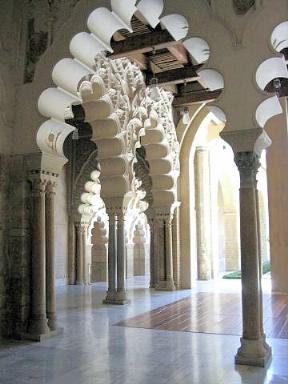 It
was Sunday, so I quickly grabbed a handful of brochures and a city map at
tourist information, then we headed to one of the sights in town that would be
open today, the Palacio de la Aljaferia. This palace was built in the 11th
century by the Moorish king, Abu Jafar Ahmed Almoctadir Bila, or just plain al-Jafar,
who ruled the area at this time. He romantically named it Dar Asurar , or House
of Joy. Predating the Alhambra, Spain’s most famous Moorish palace, it was home
to a succession of both Moorish and Christian kings and today the Aragonese
Parliament meets in a one section which is closed to the public. What is visible
to the visitor is an austere façade outside; an almost square fortress with high
walls and crenellated towers. Inside it is a beautiful airy space with delicate
lacy plasterwork arches and a large open courtyard with orange trees. Rich
coffered ceilings with gilded pineapples and gothic calligraphic inscriptions
ring the rooms of the later catholic kings upstairs. For many years it was left
to slowly fall apart, and at some point the delicate arches were disguised with
plaster and the building used as barracks. It has been recently undergone
extensive restoration; little by little the plaster was stripped away to reveal
a surprisingly beautiful monument.
It
was Sunday, so I quickly grabbed a handful of brochures and a city map at
tourist information, then we headed to one of the sights in town that would be
open today, the Palacio de la Aljaferia. This palace was built in the 11th
century by the Moorish king, Abu Jafar Ahmed Almoctadir Bila, or just plain al-Jafar,
who ruled the area at this time. He romantically named it Dar Asurar , or House
of Joy. Predating the Alhambra, Spain’s most famous Moorish palace, it was home
to a succession of both Moorish and Christian kings and today the Aragonese
Parliament meets in a one section which is closed to the public. What is visible
to the visitor is an austere façade outside; an almost square fortress with high
walls and crenellated towers. Inside it is a beautiful airy space with delicate
lacy plasterwork arches and a large open courtyard with orange trees. Rich
coffered ceilings with gilded pineapples and gothic calligraphic inscriptions
ring the rooms of the later catholic kings upstairs. For many years it was left
to slowly fall apart, and at some point the delicate arches were disguised with
plaster and the building used as barracks. It has been recently undergone
extensive restoration; little by little the plaster was stripped away to reveal
a surprisingly beautiful monument.
On the way back to the hotel we found the municipal market,
closed on Sunday, which on weekdays is busy with shoppers buying groceries at
stall after stall of fresh produce and meats. We found a nice, new-looking hotel
called Hotel Hispania nearby and went in to check it out. For €55 a night, the room was surprisingly
nice, bright, and clean with phone and air conditioning. We were realizing that
there are a lot of interesting things to see in Zaragoza and it would be worth
staying a few extra days, so we decided to move here for a few nights. The
Hispania was
only a 2 star hotel and the room was not as deluxe (no mini-bar or bathroom
toiletries!) but it was a comfortable place and the ladies at the desk were
really nice. And we parked for free in a locked garage.
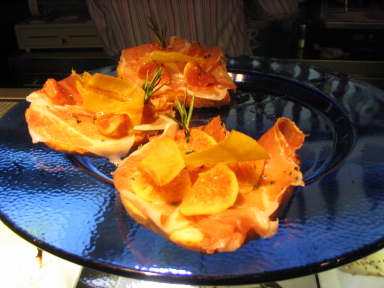 We
wandered around town and found a slightly newer section of town with a broad
avenue lined with arched arcades. Restaurants and a large department store
called "el Corte Ingles" (my favorite place!) were busy with people out for
their evening paseo. We found an interesting restaurant called Las Vegas, where
we stopped for some tapas. I had seen a report on TV a few weeks earlier about
how Spanish chefs are using tapas, the small plates of appetizer sized food, as
a canvas for some truly creative cooking. Las Vegas was certainly one of those
places. For example, I tried a tapa that consisted of a piece of peasant bread
topped with a sliced of cured ham, some fresh cut figs and a paper thin curl of
fried banana. We decided to have a dinner of some appetizers with an excellent
bottle of Spanish wine and were not disappointed. Before they brought out the
food we had ordered, the waitress brought both of us a bowl with about a
delicious half inch of a creamy cold soup made with real Foie Gras, a few curls
of the French liver pate garnishing the center of the plate. After the soup, we
were given a glass the size of a shot glass. A poached egg yolk sat at the
bottom, topped with foamy whipped potatoes and sprinkled with crispy crunchy
fried bits of ham. We were instructed to eat it with the tiny spoon provided,
‘from the bottom up’. To say the potatoes were whipped is an understatement,
they had the consistency of a delicate mousse, melting in your mouth. The
ingredients of egg, potato and ham is certainly basic, but I have never had it
prepared in such a way – it was heavenly! Then came the food we actually
ordered, but to tell you the truth, I can’t remember what it was (but it was
good)!
We
wandered around town and found a slightly newer section of town with a broad
avenue lined with arched arcades. Restaurants and a large department store
called "el Corte Ingles" (my favorite place!) were busy with people out for
their evening paseo. We found an interesting restaurant called Las Vegas, where
we stopped for some tapas. I had seen a report on TV a few weeks earlier about
how Spanish chefs are using tapas, the small plates of appetizer sized food, as
a canvas for some truly creative cooking. Las Vegas was certainly one of those
places. For example, I tried a tapa that consisted of a piece of peasant bread
topped with a sliced of cured ham, some fresh cut figs and a paper thin curl of
fried banana. We decided to have a dinner of some appetizers with an excellent
bottle of Spanish wine and were not disappointed. Before they brought out the
food we had ordered, the waitress brought both of us a bowl with about a
delicious half inch of a creamy cold soup made with real Foie Gras, a few curls
of the French liver pate garnishing the center of the plate. After the soup, we
were given a glass the size of a shot glass. A poached egg yolk sat at the
bottom, topped with foamy whipped potatoes and sprinkled with crispy crunchy
fried bits of ham. We were instructed to eat it with the tiny spoon provided,
‘from the bottom up’. To say the potatoes were whipped is an understatement,
they had the consistency of a delicate mousse, melting in your mouth. The
ingredients of egg, potato and ham is certainly basic, but I have never had it
prepared in such a way – it was heavenly! Then came the food we actually
ordered, but to tell you the truth, I can’t remember what it was (but it was
good)!
Long before the moors came here, the Romans had settled
here and named the town Caesar Augusta, which if you leave off the “Cae” part of
the name and sort of slur it as you say it, you will see how Zaragoza got its
modern name. The Romans left more than the name. As we wandered through town, we
stumbled across a section of the old city wall, and an archeological dig where
they were busy uncovering the remains of a Roman Theater built in the 1st
century. In fact, there is a string of four Roman museums, covering variously,
the theater, the river port, the forum and a small fragment of the public baths.
The museum at the theater I found the most interesting, as it took you through
time from the building of the theater to present day. We learned that by the
middle of the 3rd century, the theatrical activity had declined and
that they were going through a period of political instability and barbarian
invasions, so they dismantled their own theater and took the stones to build a
wall of protection around the city. The old quarter of the city still clearly
preserves the rectangular shape imposed by the strong walls. Over the next few
centuries, the theater site was used for different purposes, and by the 1400’s,
the area was part of the Jewish barrio and was inhabited by people who probably
had no idea that they were living in something that was partly built by Romans,
since there wasn’t much left but the foundations and a few walls.
 Zaragoza
is a good sized city, over 600,000 people, but has a comfortable small town feel
to it and friendly people. Zaragoza also seems to have a lot of Ecuadorian
immigrants, more than we have seen anywhere else. In a town where 99% of the
people are white, the community of immigrants seemed startling; their bronze
Indian faces and black hair distinctly different from the Spanish.
Zaragoza
is a good sized city, over 600,000 people, but has a comfortable small town feel
to it and friendly people. Zaragoza also seems to have a lot of Ecuadorian
immigrants, more than we have seen anywhere else. In a town where 99% of the
people are white, the community of immigrants seemed startling; their bronze
Indian faces and black hair distinctly different from the Spanish.
We were not able to find a movie theater with original
version movies here, only movies dubbed into Spanish, but we did find a good and
inexpensive internet place, part of a computer school, where we were able to
plug our laptop into their network and have a faster connection than the phone
at the hotel.
Being a typical Spanish city, Zaragoza has a lot of
churches. What I found interesting was that there are more Mudejar style church
towers here than in Sevilla! (In April I explained that Mudejar style was like
an imitation Moorish style, that seemed to have found favor here in Zaragoza in
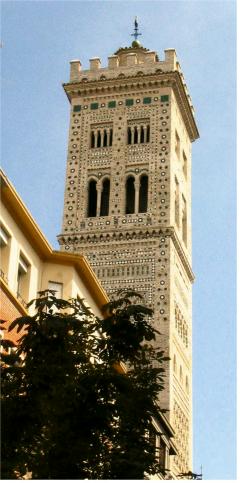
the 15th century). I counted at least 7 Mudejar towers, one of the
prettiest is La Magdalena with its golden brick inset with white, green and blue
ceramic tiles and roundels.
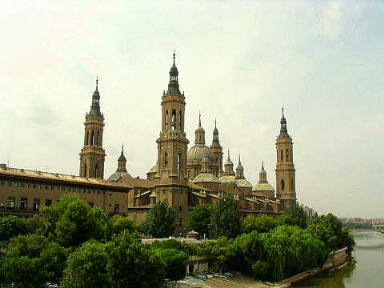 Another
interesting church is the ancient church of San Juan de los Panetes with its
distinctly leaning tower. Then you have the magnificent Basilica of the Pilar
with its towers and domes with colored ceramic tile roofs (see picture at
right). Inside the basilica is also breathtaking, and the ceilings of a few of
the domes have the added distinction of having been painted by Goya, one of
Spain’s most famous painters. Certainly he is important here, as he was born in
a nearby village and spent much of his life in Zaragoza. The domes of the
basilica are said to be his first commissioned works.
Another
interesting church is the ancient church of San Juan de los Panetes with its
distinctly leaning tower. Then you have the magnificent Basilica of the Pilar
with its towers and domes with colored ceramic tile roofs (see picture at
right). Inside the basilica is also breathtaking, and the ceilings of a few of
the domes have the added distinction of having been painted by Goya, one of
Spain’s most famous painters. Certainly he is important here, as he was born in
a nearby village and spent much of his life in Zaragoza. The domes of the
basilica are said to be his first commissioned works.
To me, the basilica is more spectacular than the cathedral,
although the latter has its own charm. The building of the cathedral began in
1189 on the site of the old mosque, and at first followed a purely Romanesque
plan. Over the centuries, the building was added to and today’s cathedral is a
startling mix of very different styles from the12th thru the 18th
centuries; Mudejar, Romanesque, gothic, renaissance, baroque and neoclassic.
One section of the cathedral houses a tapestry museum,
which I visited one afternoon while Mike went to the internet place to do some
work. On display were some 60 panels each covering a good size section of wall,
floor to ceiling. They were woven in Belgium between the 15th and 17th
century of silk and wool and to give the scene they depicted more detail, the
panels were woven with an amazing 50 threads to the square centimeter. I stood
there gawking at one of them, by myself in the large room when the curator came,
very apologetically, to tell me that he was very sorry but he was closing. “But
if you come back in the morning”, he told me, “I will let you look at the
tapestries some more”. For free, he kept assuring me. On the way down he stopped
and led me to a case displaying some magnificent vestments and pointed out the
ornate embroidery on the brocaded fabric, telling me there were 1000 real pearls
sewn on to this single garment. I don’t suppose may people spend as much time
looking at them as I did and he was happy that someone appreciated them as much
as he did.
It was time finally to leave Zaragoza. We packed up and in
the morning, first thing after a cup of café con leche, we set off. About 5
miles out of town it started to rain. Finding a bridge to hide under, we watched
the rain coming down for the better part of an hour. We could see some lights up
the road maybe ½ mile away, but couldn’t tell what they were; as the rain came
down harder, the lights were gradually obscured in rain as were the hills in the
distance and thunder boomed overhead.
Eventually, the rain tapered off a little and we were able
to see more and more of the countryside emerging from the fog of water, spray
and clouds, so we headed down the road as we debated what to do. The lights
turned out to be a rest area, with gas station and a café/restaurant and we
pulled in to get out of the rain and have some lunch. It was pouring down rain
again, and a cleaning woman was busy trying to sop up water leaking through the
large picture window, pooling on the windowsill and spilling onto the tables and
floor in front of the window.
We spent a few more hours here, enjoying our lunch and a
leisurely cup of coffee while we read books to pass the time. The rain is still
coming down and it is now afternoon, no time to get anywhere; we were only 10
miles out of town. In the end we called our hotel and went back, somewhat
sheepishly. Of course, it has finally stopped raining, but somehow, it felt like
something was telling us not to go. After our spill in Italy, I had resolved to
pay more attention to those little hunches.
We spent two more days; getting a little more organized,
making plans and hotel reservations, spending time at the internet place getting
some more work done. And, of course, the next day was sunny and nice again. The
news on TV showed that the rains had been unusually severe, and in Calatayud, a
town we would have gone through, they showed a flooded river and residents
trying to clear water-logged homes.
==================================================================================
Here are some places we recommend in
Zaragoza;
Hotel Hispania: 2 star with bath, TV,
AC, telephone and free parking, €60. Breakfast
available but not included. Avenida Cesar Augusto, 95-103 across from public
market. Tel. 976 284 928, fax 976 283 916.
www.hotelhispania.com e-mail:
reservas@hotelhispania.com
Bar Las Vegas, Paseo Independencia, 19.
Good wines, interesting tapas and meals. Pricey but worth splurging on a few
tapas. Telephone: 976 238 034
Toscana
Although I didn't mention this
Italian restaurant in the story, it is worthy of a footnote. The first time we
ate there, we both ordered a plate of pasta each plus some garlic bread, and
were horrified to see what they considered a single serving of pasta...It was
HUGE! The next time we came, one order of pasta was more than enough for both of
us, although our waiter claimed that he has had customers order a pizza to
start, then polish off a whole order of pasta by themselves. Calle Cadiz, 6.
Telephone:976 237 767
Another place I didn't mention: if you
like wine, check out this tiny bar called Bodegas Almau on Estebanes, 10. It's a
neighborhood type bar with good Spanish wines by the glass and a small selection
of standard tapas.
Previous Page
 Next Page