September 6th, 2003
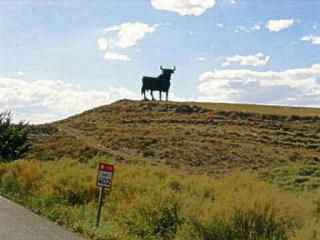 When we finally set out from Zaragoza, for good this time,
we heading to Madrid 300 km to the southwest, the sky was clear and blue. From
Zaragoza, we passed through a lot of typical Spanish landscape; rolling golden
dry hills with shrubby green plants, and the ribbon of road ahead of us
undulated with the hills while heading straight west. The rivers we crossed were
thick brown with mud from the recent rain storm. Every so often we would see the
iconic Osborne bull in the distance, as if surveying his territory from a
hilltop. Originally an advertisement for Osborne Sherry Brandy, the bull is an
enormous black silhouette usually set in a field on top of a hill so you can see
it for miles. It seems natural that this bull would become sort of a national
symbol of Spain.
When we finally set out from Zaragoza, for good this time,
we heading to Madrid 300 km to the southwest, the sky was clear and blue. From
Zaragoza, we passed through a lot of typical Spanish landscape; rolling golden
dry hills with shrubby green plants, and the ribbon of road ahead of us
undulated with the hills while heading straight west. The rivers we crossed were
thick brown with mud from the recent rain storm. Every so often we would see the
iconic Osborne bull in the distance, as if surveying his territory from a
hilltop. Originally an advertisement for Osborne Sherry Brandy, the bull is an
enormous black silhouette usually set in a field on top of a hill so you can see
it for miles. It seems natural that this bull would become sort of a national
symbol of Spain.
When we got to Madrid, we now had the challenge of finding
the hotel where we had reserved a room; all we had was a vague idea of where it
was. Getting off the highway, we started looking. We could have circled for
hours, so we stopped at a hotel called Sofitel to ask them if they knew where it
was. They did, and got a map out to show us. We weren’t far, just on the other
side of the highway. Just out of curiosity, we asked if they would take talones
for two nights and were surprised when they said they would take one talone per
night.
With the help of the map they gave me, we had little
trouble finding the other hotel, but it turned out to be in a neighborhood that
looked a bit run down. The only place to park the motorcycle was in a garage and
they wanted to charge €11 a night. The first hotel had looked so nice,
although a little remote, but it seemed nicer, so we decided to go back and
check in to the Sofitel. We didn’t care much that it was so far from town
because Mike was planning on hanging out at the hotel watching the Motorcycle
Grand Prix which was being run that weekend in Portugal. I still find it a bit
amazing that they accepted one talone per night; a €50 talone for a room that
is regularly €280?! What a deal!
The room was nice, a huge cushy bed with down pillows and a
palatial bathroom, a nice plush place to hang out for a few days. They let us
park the bike out front (no charge), in this quiet area, no one would disturb it
even if there were no guard outside all night. Not far from the hotel was a stop
for the Metro which we took into town for dinner that night. We ate at our
favorite restaurant, Casa Mingo, that is famous for their Asturian style cider
and roasted chicken. After dinner, we went to see a movie, starved for something
in English. We found a theater which shows movies in the original language with
Spanish sub-titles. It is difficult to find movies in English except in a few of
the larger towns in Spain - of course the selection is a bit limited, but
Pirates of the Caribbean turned out to be amusing so I can’t complain too much…
We discovered that Starbucks is now in Madrid so we went to get a nice cold
frappuccino to sip on this balmy evening
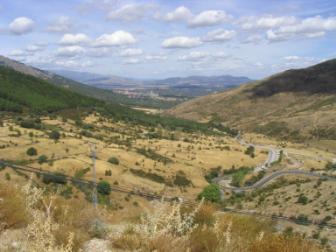 On our way out of Madrid, we stopped in town; it was time
again to find a used book store and trade in some books, and we had found the
address for a self-service laundry on the internet. It is hard to find a laundry
in Spain so we were quite happy to find this one, a clean well-run laundry with
an attendant who helped us through the process of putting our money in the
machine, getting soap, etc. This laundry was one of a Italian chain called
Ondablu, and one bonus was that they have a few computers, where for €1 per ½
hour, you can surf the internet while washing your clothes. We had gotten the
address for a bookstore that sold English books, but it turned out to be a new
book store. They directed us to another place back in the center near the
laundry, which sells used books in English as well as French, German, Italian
and Catalan, where we were able to get rid of some books and get some new ones.
On our way out of Madrid, we stopped in town; it was time
again to find a used book store and trade in some books, and we had found the
address for a self-service laundry on the internet. It is hard to find a laundry
in Spain so we were quite happy to find this one, a clean well-run laundry with
an attendant who helped us through the process of putting our money in the
machine, getting soap, etc. This laundry was one of a Italian chain called
Ondablu, and one bonus was that they have a few computers, where for €1 per ½
hour, you can surf the internet while washing your clothes. We had gotten the
address for a bookstore that sold English books, but it turned out to be a new
book store. They directed us to another place back in the center near the
laundry, which sells used books in English as well as French, German, Italian
and Catalan, where we were able to get rid of some books and get some new ones.
From Madrid, our plan was to revisit a few places we had
gone to earlier this year; the first stop was Avila, a little more than 60 miles
away. We still remember the bodega that we had discovered the last time and
wanted to go back. We had tried several times to get a reservation in the hotel
we had stayed in last time, trying both the internet and at a travel agent but
couldn’t get a reservation through the talone system, so we decided to walk in
when we got there and see what they say. No problem, was the answer. When we
first started using Bancotel Talones, we thought reservations needed to be made
through travel agencies but we were having a lot of luck just showing up. This
is such a great system.
Oh yea, the bodega was just as we remembered it. Built into
the outside of the wall just outside the Puerta del Peso de la Harina (the gate
of the weighing of flour), it is called Bodega San Segundo. Walls covered with
shelves packed with bottles of wine, barrels set along the walls as tables. The
bar was set up with several groupings of opened bottles of wine; red wine from
the area, white wine in a huge silver bowl of ice, more reds from other parts of
Spain. We tried the wine we had enjoyed last time, Convento San Francisco, and
it was just as good as we remembered. With each glass of wine, we got a
complimentary plate of tapas; a few boiled new potatoes covered with a garlicky
mayonnaise, a couple slices of baguette with a piece of cured ham, a plate of
olives…
Drinking wine at the bodega and trying different ones was
like a journey of discovery of Spanish wines for us. Ribera del Duero. We bought
a bottle of the Convento San Francisco to take with us, a whole €12 –
expensive for Spanish wine but worth it. I hope it survives the trip back to
Paris…(we asked if it were possible to mail back to Paris. Yes, it’s possible
but the cost to send it would be more than the cost of the wine itself, since to
mail it to France would be international. So much for an economic union.)
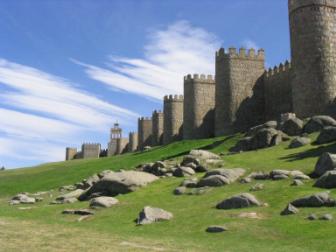 The walls of
Avila were a wonder of military architecture for their time, and today the
well-restored walls still completely encircle the rectangular old town. The
walls were started in 1090 to stave off the Moors, taking advantage of stones
left from ruined Roman walls and buildings in the area. In fact, you can
clearly see the ‘recycled” stones in the wall; various stones bearing an
inscription (and set into the wall up-side down) taken from the roman
cemetery, while other stones are carved with a hole or basin, possibly altar
stones. I took a walk around the walls one afternoon, about 1 ½ miles around.
The old town is set on a bluff, as is typical for a fortress town, at an
altitude of about 3600 feet. The view frozm one end, the paseo del rastro,
affords a great view of the wide Ambles Valley, a viewpoint where hundreds of
years ago, Avilans would watch for the arrival of invading armies. The town
was very prosperous during the 16th century, and all over the old
town you can see splendid old palacios and the home of noblemen, coats of arms
carved in stone and set over the doorway.
The walls of
Avila were a wonder of military architecture for their time, and today the
well-restored walls still completely encircle the rectangular old town. The
walls were started in 1090 to stave off the Moors, taking advantage of stones
left from ruined Roman walls and buildings in the area. In fact, you can
clearly see the ‘recycled” stones in the wall; various stones bearing an
inscription (and set into the wall up-side down) taken from the roman
cemetery, while other stones are carved with a hole or basin, possibly altar
stones. I took a walk around the walls one afternoon, about 1 ½ miles around.
The old town is set on a bluff, as is typical for a fortress town, at an
altitude of about 3600 feet. The view frozm one end, the paseo del rastro,
affords a great view of the wide Ambles Valley, a viewpoint where hundreds of
years ago, Avilans would watch for the arrival of invading armies. The town
was very prosperous during the 16th century, and all over the old
town you can see splendid old palacios and the home of noblemen, coats of arms
carved in stone and set over the doorway.
The next night
we spent in Salamanca, at a newly built “boutique hotel” called Melia Las
Claras. A travel agent had gotten us a good deal, normally requiring 2 talones
per night, we got a special price of only one talone. The room was nice, but
the bed was so hard that it was like sleeping on a board. Needless to say,
neither of us slept well that night.
Salamanca’s old
town is mostly old buildings faced in a yellow sandstone, that at sunset turns
golden in the sunlight. The tourist map we were given explained some of the
monuments to look for, such as the Plaza Mayor, which it described as
“doubtless the most beautiful arcaded square in Spain”. It goes on to explain
that it is Baroque in design and the Town Hall is built into the north side.
As far as I could tell, it looked pretty much like the Plaza Mayor in Madrid,
only a little smaller and missing the statue in the center. But like the one
in Madrid, it had plenty of cafes along its inner arcades with tables spilling
out of the shade into the sun.
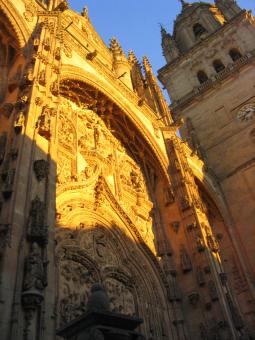 Salamanca also
boasts Europe’s oldest university and there are many intricately decorated
buildings influenced by the Italian Renaissance style. Salamanca also has not
one but TWO cathedrals to its name, one built in the medieval period. The
other, finished in the early 1700’s, was lit by the waning sunlight as we
walked past, glowing bright gold. The plaza in front of it was crowded with
people, as a free concert was going on. The city was celebrating a weeklong
annual festival with music and performances going on. Passing the cathedral,
we walked down to the river to look at the stone bridge and passed a
magnificent art-deco house with amazing stained glass windows. It was an art
deco museum, but was just closing. We’ll need to come back another time to see
the house and museum, as it looked really interesting.
Salamanca also
boasts Europe’s oldest university and there are many intricately decorated
buildings influenced by the Italian Renaissance style. Salamanca also has not
one but TWO cathedrals to its name, one built in the medieval period. The
other, finished in the early 1700’s, was lit by the waning sunlight as we
walked past, glowing bright gold. The plaza in front of it was crowded with
people, as a free concert was going on. The city was celebrating a weeklong
annual festival with music and performances going on. Passing the cathedral,
we walked down to the river to look at the stone bridge and passed a
magnificent art-deco house with amazing stained glass windows. It was an art
deco museum, but was just closing. We’ll need to come back another time to see
the house and museum, as it looked really interesting.
 We asked at the
hotel if we could stay a second night so that we could go to a concert the
next night. Yes, they said, but it would cost us two talones. Oh, well, never
mind. We’ll have to plan better next time. We walked back into town and to get
a cup of coffee on the pedestrian street and all of a sudden I started hearing
some commotion down the street with music and shouting. From a side street, we
saw a crowd emerging with a band of musicians playing some traditional music.
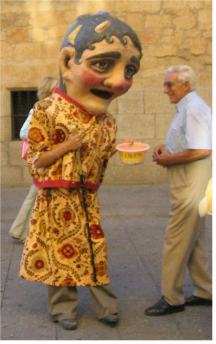
The thing that all the kids went running to see were the Cabezudos, people
dressed in costume with a huge fiberglass head. There was a bullfighter, a
senorita, a policeman, a bull; about a dozen figures in all, teasing the
children and collecting money in a small plastic basket as the parade moved
slowly down the road.
We asked at the
hotel if we could stay a second night so that we could go to a concert the
next night. Yes, they said, but it would cost us two talones. Oh, well, never
mind. We’ll have to plan better next time. We walked back into town and to get
a cup of coffee on the pedestrian street and all of a sudden I started hearing
some commotion down the street with music and shouting. From a side street, we
saw a crowd emerging with a band of musicians playing some traditional music.
The thing that all the kids went running to see were the Cabezudos, people
dressed in costume with a huge fiberglass head. There was a bullfighter, a
senorita, a policeman, a bull; about a dozen figures in all, teasing the
children and collecting money in a small plastic basket as the parade moved
slowly down the road.
Another
interesting building is called the Casa de las Conchas. Its outer walls are
adorned with a multitude of scallop shells carved in stone built by Don
Rodrigo Arias de Maldonado as a wedding present to his wife. The shells
represent the shells worn by pilgrims on the road to Santiago and are also the
emblem of the Order of Santiago to which the Don belonged. The outer wall is
broken by three gothic window, all different, with intricate wrought iron
grills. Entering the building through heavy wooden doors and passing through a
short hall, we found ourselves in a beautiful interior courtyard, square
pillars supporting upper floors with a series of arches and columns of Italian
marble and a railing of flashy carved stone that looks like wickerwork. Along
the eaves a row of gargoyles spout water into the courtyard after a rain, and
heraldic shields and carved lions complete the decoration.
Under the
“traditions” section of the tourist map text, I read an amusing story about
how “in the old days”, the university students would gather on the roman
stone bridge on Lunes de Aguas (the Monday following Easter). It goes on to
explain that during holy week, the prostitutes were sent out of the city to a
brothel set up in 1498 on the other side of the river and not allowed to come
back until after Easter. Not knowing what time the prostititutes would return
in their boats, the people would gather on the bridge to await their return
and have a picnic featuring the local specialty, a sausage-filled pie. The
tradition of having a picnic on the bridge is still celebrated, but the
brochure says nothing about whether the prostitutes still arrive by boat…
=======================================================================================================
The Ondablu
laundry in Madrid can be found
Previous Page
 Next Page