September 15th, 2003
Leaving Bilbao behind, we took the toll road, a beautiful
highway that winds through steep forested hills and gorges. After a bit, we
caught occasional glimpses of the ocean as we came down out of the mountains and
crossed out of Spain and into France.
We stopped in St. Jean-de-Luz, not far over the border, to
get some lunch and perhaps find a hotel. St-Jean is a nice town just south of
the more famous town of Biarritz. In the summer, St Jean is a busy town, with
tourists crowding the restaurants and hotels or wandering the pedestrianized
center, shopping for souvenirs and trinkets in the many tourist shops. It would
be nice to stop there for the night to hang out and enjoy the sun. We thought it
would be a lot calmer this time of year but there still plenty of tourists
about.
We found a hole-in-the-wall shop selling sandwiches on
round home-made Basque bread, with creamy goat cheese, tomatoes and ham, heated
on the grill. We chatted with the woman in Spanish while we waited for the
sandwich. I am glad we only ordered one for both of us, because when we got it,
it was huge! The bread bun was nearly 8 inches across and absolutely delicious…
We decided not to stay in St. Jean; it was a gorgeous day
for riding and still quite early. We headed east through the French countryside,
through the Dordogne, an area we had never ridden before. With all the riding we
do in France, you would think we know the whole country like the backs of our
hands but we are always finding another beautiful corner we’ve never explored
before. We rode through leafy tunnels of trees arching over the road, occasional
brown leaves falling slowly to the ground to swirl in the wake of our passing
and the sunlight strobing between the trees planted along the road. We saw acres
upon acres of grapevines and fields of dry brown corn. Occasionally we would
spot hilltops crowned by castles and forts, remnants of the medieval feudal
system, warring nobles seeking to expand their holdings, and the age of English
control of this territory.
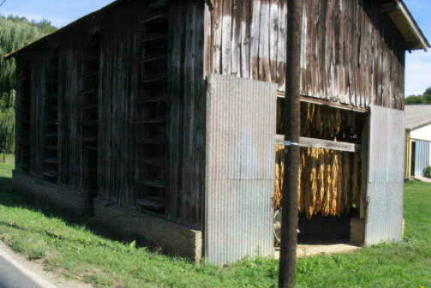 Gradually we left the wine country and as the number of
grape vines decreased, they were replaced with fields of tall tobacco plants.
Many fields were already bare, the tobacco having been harvested and hung in
sheds and barns to dry. We could see the yellowing leaves through the open doors
of wooden barns with louvered sides, designed to let the air circulate. We also
saw tobacco hanging in arched structures like greenhouses, with plastic
stretched over the arched poles to keep the rain off.
Gradually we left the wine country and as the number of
grape vines decreased, they were replaced with fields of tall tobacco plants.
Many fields were already bare, the tobacco having been harvested and hung in
sheds and barns to dry. We could see the yellowing leaves through the open doors
of wooden barns with louvered sides, designed to let the air circulate. We also
saw tobacco hanging in arched structures like greenhouses, with plastic
stretched over the arched poles to keep the rain off.
We entered the small town of Bergerac, intending to find a
place to stay for the night. The girl at the tourist information office gave us
a brochure of lodging in the area, and after we picked one out of the book, she
called them to see if they had a room and made a reservation for us. The hotel
was on a shady plaza, with trees lining the street, not far from the historical
center of the town. The room was small and in spite of the amount of money we
paid, it could be called a dump but we were tired and hot and ready to stop. It
would be ok for one night. We ferried our stuff up to the room in a couple of
trips; the elevator was tiny and made an alarming set of sounds; creaks and
groans, clanking and knocking. Mike remarked that the noise could be used for
the sound effects of a haunted elevator in a Halloween movie…
After freshening up and changing clothes, we went out to
explore. Our first stop was a bakery where we bought a couple of pavés; cookies
fresh out of the oven, like a thin, square shortbread cookie with a fruity jam
filling. We stood in the shade of the bakery’s awning juggling the hot cookies
from hand to hand, unwilling to wait for it to cool before devouring the
delicious treats. Map in hand, we headed off down the street which sloped down
towards the river and the old town.
We found ourselves in a plaza hemmed in by old
half-timbered houses and shops, an old mill house, a church and a round fountain
where women would come to wash clothing. A couple of restaurants spilled out
onto the plaza, tables and chairs shaded by large umbrellas. Huge pots full of
flowers added color. A tourist brochure I had picked up explained that this was
the square of the pelt merchants in olden times, evidently a wealthy group
judging by the old buildings in the quarter. We went into a nearby shop which
sold local wines and typical products from the region (lots of duck, foie gras
and pates), to learn a little about the Bergerac wines. The shopkeeper gave us a
taste of a few different red wines but we found them a bit light and not much to
our taste.
 Leaving
the wine shop we walked out onto another tiny square, Place de la Mirpe, blazing
with color (trite description maybe, but the effect of all the flowers in the
sun really was dazzling!). A white stone statue stood modestly behind the
display of flowers, and looking at it, I gave myself a mental head-slap. I had
been wondering why the name Bergerac was so familiar but didn’t think much of it
until I saw the statue, dedicated to Cyrano de Bergerac. (DUH!). Apparently, the
story of Cyrano was inspired by a real person, a man named Savinien de Cyrano,
whose active life inspired the author Edmond Rostand in 1897. I don’t think
Monsieur Savinien was from Bergerac, but the city has adopted him
enthusiastically.
Leaving
the wine shop we walked out onto another tiny square, Place de la Mirpe, blazing
with color (trite description maybe, but the effect of all the flowers in the
sun really was dazzling!). A white stone statue stood modestly behind the
display of flowers, and looking at it, I gave myself a mental head-slap. I had
been wondering why the name Bergerac was so familiar but didn’t think much of it
until I saw the statue, dedicated to Cyrano de Bergerac. (DUH!). Apparently, the
story of Cyrano was inspired by a real person, a man named Savinien de Cyrano,
whose active life inspired the author Edmond Rostand in 1897. I don’t think
Monsieur Savinien was from Bergerac, but the city has adopted him
enthusiastically.
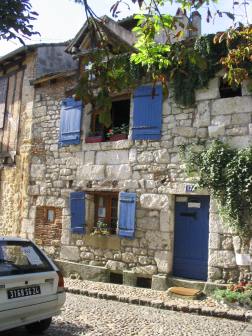
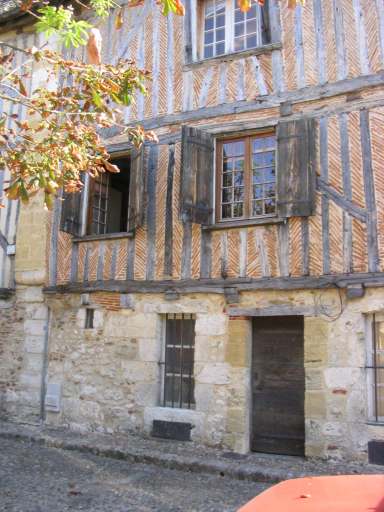
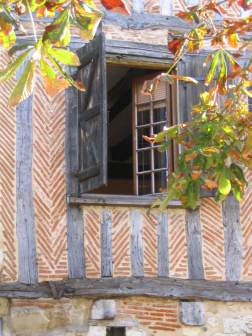 Ringing the
Place de la Mirpe were a collection of super atmospheric, drenched-in-charm
buildings that had once been the homes of master bargemen. Most of them were
built with stone on the ground floor while the upper stories were half timbered.
The half timbered walls were filled with loam, a mix of mortar and straw, and
thin bricks laid in an unusual herringbone pattern. In the midst of these houses
sat one that was built entirely of stone, periwinkle blue shutters framing the
flowery window boxes in the window. We noticed a small sign (in English and
French) in front which announced that it was a bed-and-breakfast, so we knocked
on the door.
Ringing the
Place de la Mirpe were a collection of super atmospheric, drenched-in-charm
buildings that had once been the homes of master bargemen. Most of them were
built with stone on the ground floor while the upper stories were half timbered.
The half timbered walls were filled with loam, a mix of mortar and straw, and
thin bricks laid in an unusual herringbone pattern. In the midst of these houses
sat one that was built entirely of stone, periwinkle blue shutters framing the
flowery window boxes in the window. We noticed a small sign (in English and
French) in front which announced that it was a bed-and-breakfast, so we knocked
on the door.
A French woman answered our knock, and realizing that we
didn’t speak French and she didn’t speak English, she got her partner to come
and talk to us. The partner turned out to be an American and the owner of the
house, and loved to talk about the history of the town and his house. He
explained that the house was built in the early 1600’s and was the oldest house
in town. He has only a few rooms and was apologetic that he couldn’t show them
to us as they were occupied. One room was in the former pigeon loft overlooking
the square. The price was quite reasonable too, at 50 to 58 euros for two people
including breakfast. Boy, I sure regretted having settled for the place we were
staying in…
 Continuing
our chat, he told us about how Bergerac had been in the middle of a religious
war. King Henri IV had signed an edict authorizing the Protestants to freely
practice their religion, but when Louis XIV came to power, he decided that he
wanted to return the town to Catholicism. He ordered the destruction of the
protestant temples and the homes of those who would not agree to convert. Fires
that were sparked quickly spread from house to house; homes that were close-set
within the confines of the city walls. The half-timbered construction of wood
and loam proved to be highly combustible and soon most were burnt to the ground.
The only house left standing on the square was the little stone B and B. When
the other houses were rebuilt, one concession was made to reduce future fire
hazard, and that was to build the ground floor with stone instead of
half-timber.
Continuing
our chat, he told us about how Bergerac had been in the middle of a religious
war. King Henri IV had signed an edict authorizing the Protestants to freely
practice their religion, but when Louis XIV came to power, he decided that he
wanted to return the town to Catholicism. He ordered the destruction of the
protestant temples and the homes of those who would not agree to convert. Fires
that were sparked quickly spread from house to house; homes that were close-set
within the confines of the city walls. The half-timbered construction of wood
and loam proved to be highly combustible and soon most were burnt to the ground.
The only house left standing on the square was the little stone B and B. When
the other houses were rebuilt, one concession was made to reduce future fire
hazard, and that was to build the ground floor with stone instead of
half-timber.
From Place de la Mirpe, we walked a short distance down to
the Dordogne River, where we saw a couple of old-style barges moored. This was
the riverport of Bergerac, once a very busy place, importing wood from the
Auvergne for making wine barrels, and shipping out Bergerac wines, much of it
destined for England. The barges in the water are recreations of the barges
traditional to the area and now ferry visitors up and down the river on
sight-seeing trips.
The next day we were back on the road again. The noisy
elevator was in the process of being dismantled by a repairman, so we made three
trips back down three flights of narrow marble stairs with our bags. This place
was definitely not worth 70 euros, and I was half mad at myself that we had
stayed there. Especially in view of what could be had for 50 euros elsewhere. Oh
well, next time we come back to Bergerac, we’ll stay in the B and B.
Another gorgeous day. The sun was shining and the morning
air had a brightness to it, clean and crisp. It was one of those stellar days
that filled me with a feeling of something close to elation to be riding through
this beautiful country road on such a wonderful day. As we left Bergerac, the
Cyrano theme was reinforced by the names of the wineries and shops along the
road; we saw one winery called Cyrano et Roxanne. Following the road in the
direction of Auvergne, we passed more tobacco fields in the process of being
harvested and barns full of drying leaves. From time to time we would pass by a
chateau or castle built upon a hilltop. One such place was a small town called
Beynac, its castle built at the apex of a cone-shaped hill with the town built
on the slopes below; densely packed houses spiraling up as if to reverently
touch the walls of the castle. This region of the Dordogne is definitely an area
worth exploring in more detail, loaded with history, medieval castles and
picturesque villages.
From the Dordogne we rode back through the Auvergne, hoping
to see an autumn display of colorful leaves. I have to report that it was either
still too early or the wrong types of trees but in spite of this the ride was
still nice. The days are feeling autumnal, and the mornings are cool enough for
us to see our breath. Heated clothing makes our morning ride pleasant and soon
it is warm enough to turn the heat off all together.
A few more days of riding however, and both Mike and I
decide that we are (gasp! Dare I say it?), tired of traveling, and the fully
loaded bike is heavy and a lot of work to maneuver around the curves. Ever since
our fall in Italy, we never did get back in the groove of riding, we were
feeling more nervous and less trusting of the bike. We decided to go back to
Paris early to spend the last few weeks of our stay in Europe in the comfort of
our favorite hotel, the Suitehotel and visited with many of our friends there as
we prepared to get on a US-bound plane.
Previous Page