September 11th, 2003
From Salamanca, we continued our journey heading eastward again, following the Duero River through groves of oaks and poplar trees. The wine, Ribera del Duero comes from this region and as you might expect, the fertile broad valley was filled with rows of grape vines and wine bodegas. Wine has been grown here for a long time, and I read that in the town of Aranda de Duero, the ground under the town is honeycombed with underground wine storage made in the middle ages. The area is rich in history too; prehistoric man left his traces here as did dinosaurs who left footprints and bones. Celt-Iberians who were succeeded by Romans, Visigoths, Moors, and finally reconquered by the Spanish. The river valley is studded with Moorish castles such as the one at Penafiel or Gormaz, and Spanish cathedrals (such as El Burgo de Osma), monasteries (everywhere) and walled cities (ditto).
The landscape changes gradually, as the road starts to climb out of the valley, grape vines are replaced by oak trees then pine trees with bare straight trunks and flat crowns. These pines have a distinctive shape and whole groves of them look like stands of green umbrellas blown inside-out by the wind. The hills are rocky and Scotch pines become prevalent, with their twisted trunks gleaming red through the branches. The importance of the pines is marked by the names of some of the villages, like Los Pinares, or San Miguel del Pino.
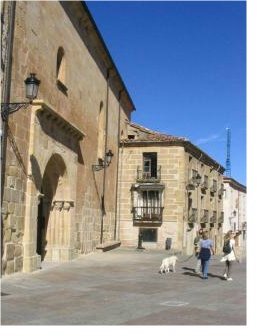
We came to a small town called Soria and our first stop was tourist information. There aren’t many hotels in town and the only 4 star in town is full, so we ended up in a small pension in a crummy room for 45 euros. (Sorry, I get a little grumpy paying that much in Spain for a 1 or 2 star place when I think what we could get with a €50 Talon). It was siesta time and the streets were deserted but we went out anyway, in search of a cup of coffee. Like I said, the streets were dead quiet and many buildings in the old city were abandoned, broken windows hanging on broken hinges, boarded doors covered with graffiti and ad posters. All of the shops were closed, with metal curtains pulled down obscuring the windows and giving the passerby no clue as to what the shop might be nor if it is even still in business. A few brazen tourists were out wandering around, tour books in hand looking at the12th century churches and palacios of “austere grandeur”. Austere, because most of the monuments seem to be almost completely unadorned, built in a Romanesque style which is very plain. Perusing the booklets I got at the tourist office, I saw that the town also boasts two hermitages and a monastery of the order of the Knights Templar, of which only some beautiful arches of Arabic design remain. It always amazes me how many churches there are in Spanish towns. The tourist brochures also keep emphasizing the “singular setting of Soria in the unforgettable and unspoilt nature of the region and the Rio Duero which looks like a long pond”, and the “relaxation and peace in the least populated province of Spain”.
Not much in the mood to look at gloomy churches, we headed over to the Numancia Museum after siesta. Numancia is the name of an archeological site a few miles out of town which was once a Celt-Iberian town. When the Romans came along, they tried to take over the town but were so fiercely resisted by the Celts that the Romans ended up destroying the town after a long siege lasting over 20 years and built a new town on the rubble, 133 years before Christ. The museum was interesting but confusing; prehistoric, celtic and roman artifacts from different sites were sort of jumbled together and it was difficult to get a sense of time from looking at the display.
Coming out of the museum and into the square at the mouth of the pedestrian area, we were hit by a wall of noise. Where there had earlier been an empty plaza, there was now a vast crowd of teens, perched on walls and benches, gathered in doorways and congregating in the middle of the plaza all chattering loudly like a flock of crows. Shops reopen after siesta are full of mothers and teenaged girls buying back-to-school clothing. We battled our way through the plaza to visit a wine bar recommended by someone we had talked to, in hopes of finding a place like the bodega in Avila. We found instead, a bar which served only a few kinds of wine, out of a bottle with no label and tasting like it was home-made. The bartender was charming though and was happy to recommend a few restaurants where we might enjoy eating dinner.
According to one booklet I read, the town had great affluence in the 16th and 17th centuries, due to the large number of cattle and sheep owned by the nobles here. By the end of the 17th and 18th century however, many people emigrated including the nobles, substantially reducing the population both in Soria and throughout the province. What I found interesting is that it later goes on to mention the houses of the Indios in a town called Vinuesa in the Duero River valley. The Indios were the Spanish emigrants who, in the last century, returned to Spain after making their fortunes in Latin America. We might have to check it out on the next trip through the area.
 From Soria we made a stop
in Burgos for the night and stayed in another hotel for a Talone. It called
itself a “style” hotel, although the room was charmingly furnished, it was tiny
and to reach my side of the bed I either had to climb over the desk or over the
bed. No matter. We found that the hotel offers free coffee or tea, delivered to
one’s room, and lost no time having a nice hot cup of café con leche.
From Soria we made a stop
in Burgos for the night and stayed in another hotel for a Talone. It called
itself a “style” hotel, although the room was charmingly furnished, it was tiny
and to reach my side of the bed I either had to climb over the desk or over the
bed. No matter. We found that the hotel offers free coffee or tea, delivered to
one’s room, and lost no time having a nice hot cup of café con leche.
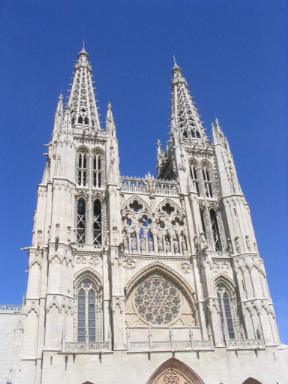
The last time we were in Burgos, last April, it was rainy and bitterly cold. I was sick and had no interest in emerging from our hotel room into the cold wind so we didn’t see much. Looking at my photos from April, the cathedral loomed dark grey over the roofs of the town. This time, the sun is shining and the filigreed stones of the cathedral glow a light grey, almost white in the bright sunlight. The church is built in a frothy gothic style with lots of pointy spires and steeples. A stop-over on the French pilgrim route to Santiago de Compostela, this church was one of the checkpoints along the way and is said to be the third largest cathedral in Spain.
In the morning, we picked up a fresh baked bread from the bakery, and had a nice breakfast in our room with our (free) café con leche, then began the process of packing up to leave. A few miles out of Burgos, we passed the actual pilgrim trail, which passed over the highway on a bridge. A few clumps of modern-day pilgrims were walking the trail, with their hiking boots and backpacks. Although their gear is much more modern than the medieval pilgrims, many were still wearing the scallop shell insignia.
Our last stop in Spain was in Bilbao. We had reserved a room in a hotel on a bluff overlooking the city, but when we got there, it looked like the facade of the hotel either was in the process of being remodeled or else it just needed it badly. It was still early so we decided to check out one of the other hotels on the bancotel list. Driving back into the center, we stopped at a light when we suddenly felt a thump from behind. A car had run into the back of us. Welcome to Bilbao.
To make a long story short, there was little or no damage, just a hassle, and although we waited for about an hour in the hot sun, no police car ever stopped. A passing Spanish motorcyclist stopped to mediate and call the police for us. The Spanish driver of the car was very annoyed at being detained and periodically would start waving his arms and start ranting again in Spanish about having to stay when nothing was hurt he only bumped us a little, but in the end we all tired of waiting and we all went our separate ways. For all that, when we finally reached the hotel we wanted to check on, it was full.
Navigating in Bilbao can be an exasperating experience, because many of the street signs are bilingual; that is to say that they are written in Basque and Spanish. The problem is that some of the signs have been attacked by pranksters or Basque separatists and all traces of the Spanish directions have been painted out with white spray paint, leaving the tourist faced with a totally unfamiliar and bizarre language. You can’t be sure if the sign indicates the name of a street or a building or ? Who knows?
Having lost our patience in spending time looking around for a hotel, we went back to the original one where we had a reservation, the Barcelo Avenida. The room turned out to be very nice, with a unique bathroom layout. The bathtub was set in a glass surround, and from the bed you could see through a window that separated the tub from the bedroom into the blue tiled bathroom. A pull down window shade gives the bather privacy and a frosted glass door hides the toilet room. (oh, yes, by the way, they WERE in the process of remodeling the façade of the building. That made me feel a little better).

Although a little ways from town, we weren’t far from a metro stop that would take us into town. We went into town to see the famous Guggenheim museum of modern art. Call me a philistine, but the most interesting thing about the museum is the avant-garde building, with its curving, contorted limestone walls plated with sheets of titanium. An enormous chia pet sits in the plaza at the entrance. Ok, ok, it is a piece of art by Jeff Koons, a huge sculpture shaped like a dog and covered over every inch with a patchwork of blooming flowers of all colors. Inside, contrasting against the remarkably high curving white walls of the atrium hung a black Calder mobile, spotlit from sun coming in through a skylight. One hall held a few large-scale sculptures and another had a whole lot of mobiles and sculptures by Calder, balanced on air and trembling with every current of air.
We were underwhelmed by the Guggenheim and went out to explore the rest of the town. On Saturday afternoon, not much was open and few people out on the streets except in the shopping area. Now it’s Sunday and the town is even deader including the shopping area, if that’s possible. Where is everyone? Looking for food for dinner we saw a few bars but no sign of tapas or menus on the counters. The hotel had given us addresses for a couple of tapas bars, but so far they were all closed. We finally found one bar that had tapas and struck up a conversation (half English, half Spanish) with two local women who recommended we try the local Basque white wine, called txakoli (pronounced something like chok-o-LEE). Waiting expectantly for us to taste it and pronounce it good, they then paid for it before saying goodnight and leaving.
We tried some of the tapas, which are a little different here from other parts of Spain. Platters of tapas are set out on the bar and one either takes what one wants or the bartender with give you what you point at. They are almost always some sort of topping on a small slice of baguette and skewered with a toothpick. Toppings range from ham or cheese, fish – anchovies, tuna, smoked salmon, to small Basque sausages or breaded and deep fried prawns. When it is time to pay, one simply presents their plate of toothpicks to be counted. Apparently this particular bar was in the tourist guides because it was gradually filling up with foreigners. Time to leave.
After sharing some tapas, we were still hungry. Walking back to the metro, there were no other places open at 10pm and I wonder if the bar we were in earlier was filled with people simply because it was the only one open? I know we are in the far north of Spain, in Basque country but it still seems shockingly early for things to close. Near the hotel, a Chinese restaurant is open and we gratefully order some food to take back to our room.
A friend later e-mailed us that he found Bilbao one of the most boring towns he had ever been in. And to let him know if we found any decent restaurants. Now he tells us!
 Next Page