April 17, 2003
Sevilla at last!
Wreathed in sunshine, por fin, Semana Santa is finally in full swing. The first
four days were almost a total write-off due to rain; most of the pasos are far
too costly to chance being water-damaged but there are 4 more days and many
processions left to go. It seems all of Sevilla - tourists and Sevillanos alike
- are in the streets in anticipation of the afternoon’s procession due to leave
the church shortly. It is Holy Thursday and mass has just let out; today is a
special day because everyone who has attended church is dressed even nicer than
usual. The men wear black suits but it is the women who look spectacular in
their simple black dresses and lace mantillas. They wear a high tortoise-shell
comb at the back of their head with the black lace scarf called a mantilla
draped over it and fastened at the back with a coral and gold pin. This
tradition is very old and symbolizes the mourning for the death of Christ. In
pairs or groups the mantilla clad women make a very arresting sight and we
foreigners find it hard not to stare – especially when she is young and pretty
to start with!
It is on this day that we arrive in Sevilla, without a street map, and driving
instructions that had us coming into town from the north instead of the west.
The streets of Sevilla are typical of most old European cities; to call these
streets a maze would imply that there is some organization or system. The
streets change names so frequently that one often won’t name street names when
giving directions, for the most part relying instead on landmarks such as
churches or plazas which are plentiful here. There was no deficit of people
willing to point us in the right direction, though, and thankfully we didn’t
have to drive through the center of town; fully loaded with our gear, the
motorcycle is heavy and easily dropped on the narrow one-way streets and
slippery cobblestones. Negotiating the one way streets is best done on foot.
Once at the apartment, we then had the challenge of actually getting in. Our
landlord, Pepe seemed surprised to hear from us and told us he wasn’t expecting
us for two more days. After a few phone calls he finally said he could let us
rent one of the apartments for 100 Euros per night for two nights because our
apartment is occupied. Being semana santa, Sevilla is crowded with foreigners
and the thought of getting back on the bike to search for 2 nights lodging was
not appealing. (note: we are paying about €930 for one month in the apartment
so we were a little stunned to be charged €100 per night when we thought we had
already paid for everything. Checking with the school on Monday, we found that
the school agreed with us as to which day we were supposed to arrive so we were
all confounded as to what went wrong.)
After getting settled in our new home for 2 nights, we changed and went to meet
our friends, Bob and Hae Shin, who are staying for a week in the same building
we are in. Friends from Portland and now ex-pats in Italy, Bob is a flamenco
guitarist and his Korean wife is working for the U.N. in Rome. Hae Shin wanted
to see Semana Santa in Sevilla at least once so they managed to get a week off
to come and see the spectacle. After sitting in the plaza eating tapas and
catching up, we went to watch a relatively short procession that would pass by a
church not far away. Standing on the narrow street, we waited for the procession
while the sidewalk gradually became packed with other spectators. Soon enough,
the first sounds of a snare drum echoing through the streets, then we saw the
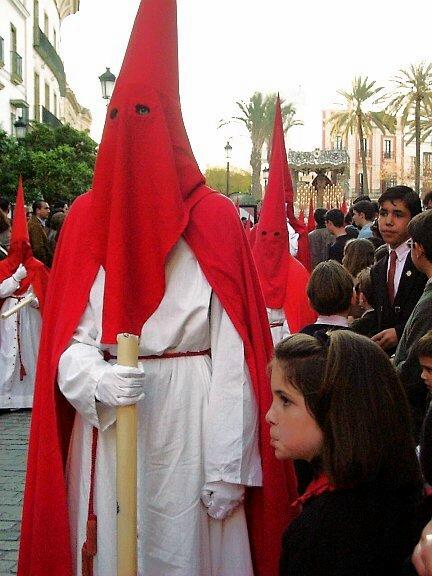
first of the nazarenos holding long fat candles. As in all of these processions,
there were frequent stops to wait for the paso to rest, then catch up with the
rest of the parade. In the meantime, the candles continue to burn, dripping
melted wax on the pavement. For weeks afterwards, the wax is there until the
weather gets warm enough to melt and stick to the tires of passing cars. Not all
the melted wax ever reaches the pavement, though, and many of the nazarenos we
saw were speckled with melted gold wax having been dripped on by another’s
candle – it’s not easy to see through the narrow eyeholes cut into the hoods
they wear and are not always paying attention to where their candle is pointed!
I saw a few close calls when someone halted suddenly and the one behind wasn’t
paying attention but I have yet to see a flaming nazareno. Many of the children
spectators dodge out into the street whenever the procession halts, begging for
drippings from a candle in order to make a ball of wax larger or holding out a
piece of foil crushed into a small ball to get started on one. Some of the
bolder boys had large multi-colored wax balls the size of a large orange and the
children with none would look on enviously and beg to be able to hold it. Behind
the nazarenos came a phalanx of barefoot penitents carrying crosses and the
first paso which stopped right in front of me. Hemmed in on all sides and almost
crushed up against the red velvet drapes of the paso, my breath clouding the
ornate silver-work, I was almost claustrophobic. (I told you the street was
narrow!) Soon enough the man guiding the paso gave the signal to proceed and on
three and in unison the paso bearers heaved the float back on their backs and
continued. They approached the church, laboriously turned the float
perpendicular to the street then went up to the door, where the paso kneeled in
respect then slowly backed up and turned to continue on its way up the street.
Mary followed on her paso, en suite, with the usual attendants and incense
bearers and paid her respects as well.
Hae Shin said there was a particular procession she wanted to see, so later that
evening we were winding through the streets to reach the other side of town, Bob
leading the way and stopping often to consult the map. We are heading for the
Macarena district for a procession that is due to leave the basilica at 12:30 in
the morning. There was a huge crowd when we got there, it seemed like the
closest we could get was a half kilometer away, but no matter, I was glad we had
gone. The first paso depicted Jesus as a condemned prisoner with several roman
centurions with headdresses adorned with white ostrich feathers and Pilate
relaxing on his throne. It was hard to see many details but suffice it to say
that the luxurious decoration belied the solemnity of the scene. Following the
paso were a large group of Nazarenes dressed in Roman garb matching the
centurions on the float – all we could see was ostrich feathers bobbing above
the heads of the crowd. There must have been 150 of them, but wait there’s more!
After them came an endless stream of the guys with the pointy hats and tall
silver candlesticks. They kept coming out of the church and after about 20
minutes of seeing them parade by, Bob joked that there was a machine inside the
church stamping them out one by one. I could almost believe it! The slow
progress of the paso meant the procession didn’t move very fast but there were a
vast number of penitents with this paso. By my watch it took half an hour for
just the last group to pass.
Finally they had all left the basilica and the crowd anxiously awaited the
virgin’s paso. As she left the church a huge cheer went up and someone in the
crowd cried out “Macarena!”, and the rest responded “Guapa! Guapa!” (Beautiful
Lady), continuing to call until she had passed. I had to go to the Basilica a
few days later to see how splendid the float was; elaborate silver all around
the sides polished to a high gloss, silver posts holding up the canopy of purple
velvet so encrusted with embroidery of gold thread it was hard to see the
fabric. Her robe was equally as lavishly embroidered. The bank of white candles
had burned down quite a bit and the white flowers had wilted a little but was
still impressive to see and incredible to think that this enormous thing could
be carried by humans.
As I said, this particular procession left at half past midnight and would
trudge through the streets until reaching the cathedral in the center of the
city. There it would enter and be blessed. After leaving the cathedral it would
wind its way back to the basilica where it started out, non-stop until 1:00 in
the afternoon more than 12 hours after it started. Holy Thursday is the peak day
of Holy Week, in which there are 7 different processions in different parts of
the city at different times of the days, converging on the cathedral and back
again. Wait, that’s just the afternoon processions. There are 6 more that go on
throughout the night.
By Sunday there is only one procession left, this one showing the corpse of
Jesus in a transparent glass coffin and a lavish spread of flowers. All through
the city, the tires of cars passing by make a squealing sound because of the wax
on the pavement and making them sound as if they are racing …
Footnotes:
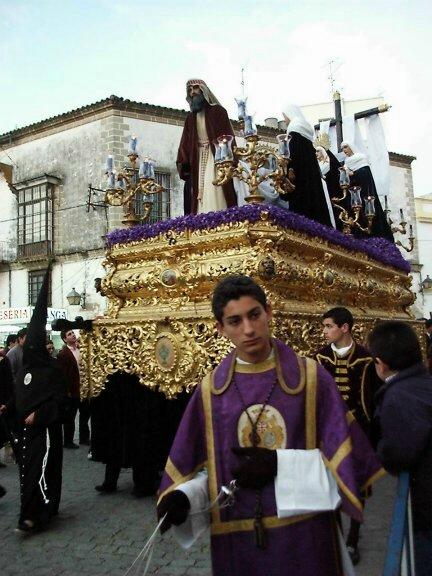
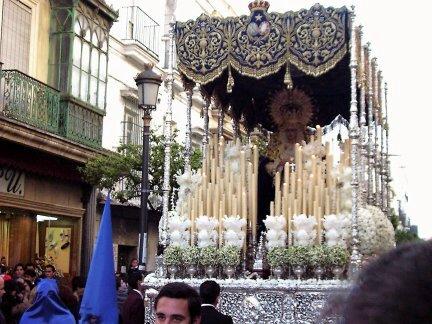
Unfortunately I have no digital photos of Semana Santa in Sevilla because our
digital camera isn't good in situations with low light or movement. It is also
getting a bit flaky in its old age (aren't we all?). I do however have photos
from Semana Santa in Jerez de la Frontera, taken several years ago. They are not the greatest
photos but should give you a better idea of what I am talking about. One of them
is a photo of a Nazarene with his candle and a typical paso of Mary in the back
ground. Another is a photo of a different paso of Mary; although they are from
different churches, they follow the same pattern. The last photo is a paso with
Jesus being taken down from the cross and carried away on a stretcher. If you
look carefully you can see the feet of two of the men carrying the paso from
underneath.
Previous Page
 Next Page