May 17, 2003
Hi, everyone. Time has passed so quickly and I can’t believe our time in Sevilla has passed so quickly. We had originally planned to stay for one month but we were having so much fun we decided to stay for one extra week. When we came, it was rainy and cold one day and warm and dry the next, but for the last 2 or 3 weeks the afternoons have been sunny and hot, reaching 95F during the day. There are lots of things to do, and of course we were taking Spanish classes 4 hours a day so before we knew it, it had gotten late in the evening and we had yet to eat dinner. We seemed to have fallen quite naturally into the Spanish rhythm of eating dinner late in the evening.
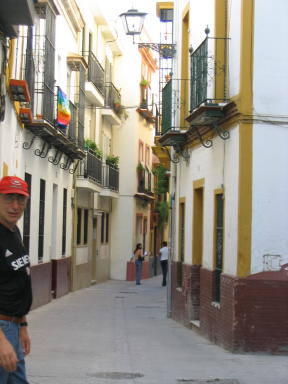
I think by now I have walked through all parts of the city in spite of feet that hurt from walking so much. There is always something interesting to see and ALWAYS new ways to get lost! I can’t tell you how many times I will take the wrong way even though I know Sevilla fairly well. I recognize the intersection and say to myself, “I have been lost here before!” The “old” part of Sevilla is fairly large and one of the most confusing cities that I have tried to navigate. The streets usually look nothing like the map, and the street signs, usually a tile pasted to the wall near the corner, are not always in evidence.
We have a theory that the streets were planned this way in order to confuse invaders and provide points of ambush, and I can believe it! A street can suddenly become so narrow a car must fold its side mirrors in or drive with two wheels on the sidewalk in order to fit through, or become an alley so narrow that you could put your hands on your hips and be able to touch both walls with your elbows. Streets encounter other streets at crazy angles and rarely run parallel to each other, nor do they ever run straight for very long. Sometimes a street will widen into a plaza with a church or tables for a nearby bar. One day we sat at a table in a plaza, watching one car after another try to negotiate a sharp left hand turn into a narrow street (one of those mirror folding ones), holding traffic up while they tried to figure out how to enter the mouth of the street – usually one of the passengers would get out to direct the driver.
Driving is hazardous in this city but to walk can also be crazy and you often end up walking in the street. It is difficult to imagine not having ample sidewalks and building facades that are not aligned with each other, but here it is normal for a sidewalk to suddenly become too narrow to walk on or disappear all together. On our walk to school, we take a street that has a lot of traffic on it and facades at crazy angles to each other; the sidewalk dwindles to the width of a curb and one must wait for a break in the traffic to pass another person coming towards you. One must also always be vigilant for pet doodoo on streets and sidewalks; while not quite as bad as in France, there is enough here to always need to watch ones step!
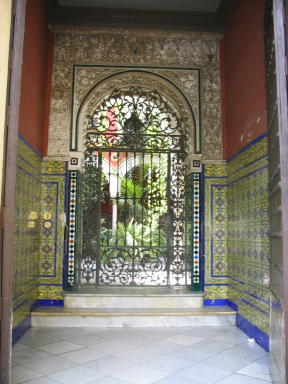 As
is typical throughout most of Spain, most homes are built in a traditional style
that came from the Romans and later, the Moors. From the outside, the building
is fairly plain, typically painted white with a heavy wooden door and a few
windows barred with wrought iron. In Sevilla, the trim is painted in a
contrasting color of golden yellow or a shade closer to the color of mustard.
The two or three upper stories usually have narrow balconies no wider than a
foot and a flat roof which is used as another patio and a place to hang clothes
out to dry in the sun. In the afternoon, the wooden outer doors of the houses
are left open wide enough for a passer-by to glimpse the tiled vestibule and an
ornate cast- iron gate. Through the gate, you will normally see a tiled
courtyard, open to the sky, with arches and columns all around, many with a
small fountain in the middle and leafy potted plants and palms. It is almost as
if the house sits with its back to the outside world and only reveals it true
beauty to those who are lucky enough to gain access inside. The various rooms of
the house open into the courtyard to take advantage of light and cool air
produced by the quantities of marble used in construction – not to mention 3
foot thick walls as are found in the older buildings. As I said earlier, it has
gotten quite warm lately and passing by one of these open doors you will feel a
blast of cold air as if you had just walked in front of an air conditioner.
As
is typical throughout most of Spain, most homes are built in a traditional style
that came from the Romans and later, the Moors. From the outside, the building
is fairly plain, typically painted white with a heavy wooden door and a few
windows barred with wrought iron. In Sevilla, the trim is painted in a
contrasting color of golden yellow or a shade closer to the color of mustard.
The two or three upper stories usually have narrow balconies no wider than a
foot and a flat roof which is used as another patio and a place to hang clothes
out to dry in the sun. In the afternoon, the wooden outer doors of the houses
are left open wide enough for a passer-by to glimpse the tiled vestibule and an
ornate cast- iron gate. Through the gate, you will normally see a tiled
courtyard, open to the sky, with arches and columns all around, many with a
small fountain in the middle and leafy potted plants and palms. It is almost as
if the house sits with its back to the outside world and only reveals it true
beauty to those who are lucky enough to gain access inside. The various rooms of
the house open into the courtyard to take advantage of light and cool air
produced by the quantities of marble used in construction – not to mention 3
foot thick walls as are found in the older buildings. As I said earlier, it has
gotten quite warm lately and passing by one of these open doors you will feel a
blast of cold air as if you had just walked in front of an air conditioner.
I think that most of these old buildings have now been converted into apartments for multiple families. Most of these places are very old but I am happy to say that I have seen many buildings being renovated and rehabilitated.
The building we live in is a little more modern; the apartments are situated around a cobblestone courtyard that serves as a driveway for the cars who park underneath the building. We have one bedroom, a bathroom, a small living room and a tiny kitchen with a refrigerator and two burners. We also have a washing machine for washing our clothes in cold water and a drying rack to set in the living room in front of the French doors that open onto the typical narrow balcony. A tree arches over the front gate which opens directly onto the street. The tree is blooming now, sporting purple trumpet shaped flowers which drop from the tree and are sticky underfoot. In the mornings the tree is filled with birds, flying from branch to branch and their song blends with that of the caged canaries set on balconies to get some fresh air. Our little apartment is in the north part of the city, in what was once the Jewish quarter. To the left, our street slowly dwindles down in size until it ends in a curb with tables for eating tapas from the bar at the corner. 8 or 9 little boys live nearby and often play in the alley, practicing their soccer moves or sit in a doorway with their coloring books.
We have settled into life in Sevilla after the crazy week of semana santa. We get up in the morning (earlier than I would wish, some days), and on our way to school we stop at a bar for our breakfast; a creamy hot café con leche (espresso with hot milk) served in a glass the size of a juice glass, a bread roll cut in half and toasted, and a glass of freshly squeezed orange juice out of a rube goldbergian machine that most bars have. The oranges are placed, whole, into the hopper on top which feeds the oranges into the machine one by one, cuts them in half and squeezes them, the whole process visible through the plastic front.
When our classes are done at 1pm, it is time to eat again. The stores close around 2pm and won’t re-open until about 5, so there’s plenty of time for a nice big lunch or perhaps some tapas if we are not so hungry. The streets are pretty deserted at this time of day, save only tourists trying to look through grated shop windows or standing on the sidewalk, map in hand trying to figure out where they are.
By 5, the city is stirring again, shops opening up and shoppers filling the streets. Often we will go out shopping this time of day or to take care of errands. Some days we go on a trip to a local monument with a guide from school (giving the tour in Spanish, of course!).
Around 7:30, Spanish people fill the streets, just strolling, stopping to chat with friends or to have a café con leche in a leafy cool plaza. The Spanish won’t be eating a real dinner for a few hours yet, so they are likely to stop in at one or more bars for a snack and a quick beer. If the weather is warm, this is a good time to take a walk because the sun is less intense but it is still light out.
By 11:00pm it is time to eat dinner and the Spanish are starting to filter into the restaurants (already filled with tourists who can’t wait that long to eat!).
 Next Page