May 20, 2003 Sevilla, part two
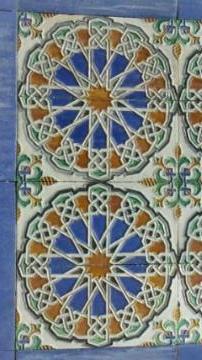
As I mentioned earlier, I love walking through this city. There are always interesting things to see; a glimpse into an astonishing courtyard, elaborate churches, buildings decorated in a turn of the century style with tile pictures and ornate details, or built and ornamented in a Mudejar style. The “Mudejar” style is a favorite one in Sevilla and is an imitation of the Moorish style of building and ornamentation. Tiles with geometric patterns, rounded arches shaped like a horseshoe, elaborately carved plasterwork and wooden ceilings with geometric patterns of stars are some of the common elements. A peek into the foyer of a building, called Zaguan, will usually reward you with a glimpse of old tiles on the wall, from the floor to about shoulder height. More often than not they will be mudejar style, imitating the elaborate cut mosaics of the moors. Other homes have tiles made in the gypsy barrio of Triana sporting baroque swirls of flowers in bright colors. Recently, tiles manufactured before the 60’s have been declared a civic treasure and were added to a list of protected elements that reflect the customs and traditions of the city.
On my way to school in the morning, people are already starting their day. At one end of the alley, the cobbler is starting on today’s repairs, sitting in a dark hole-in-the-wall shop on a low stool sewing the shoes by hand. Housewives and shop keepers are washing windows, polishing marble steps and wiping down window sills, sloshing the dirty soapy water over the sidewalk in front of their space to clean it as well. The fish shop is open in the morning, a small room completely tiled in plain white tiles, fresh fishes and shellfish displayed in trays of crushed ice.
Taking the back way, the way with less traffic, I pass by three immensely tall marble pillars left from a temple built by the Romans. The other pillars have long been gone, some removed to decorate a park on the other side of town, others taken perhaps to use in building a palacio somewhere. The Plaza Alfalfa, once the site for a Roman Forum, then later a market-place for selling hay for feed, is now host to a pet market on Sundays. Vendors there sell any sort of bird imaginable as well as a few dogs, cats and rabbits. There is also a few pieces of an aqueduct, built by the Romans then restored by the moors, along a busy road on the way to the train station.
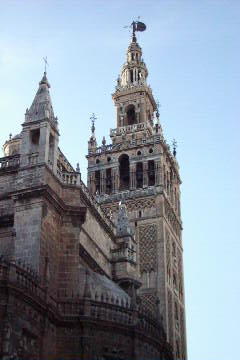
There are traces of the moors every where in Sevilla as well. One of the most famous symbols of the city was built by them, and that is the bell tower of the cathedral, called the Giralda. Throughout history it was typical that a conquering people would destroy the religious centers of the vanquished and build a larger one in its place. And so it was in Sevilla too, that after the Christians reconquered the city from the moors, they built a grand cathedral where the mosque once stood. The Giralda was once the minaret of the main mosque, with a weathervane that the Christians stuck on top. The huge revolving statue of a woman is supposed to represent Faith and is called the Giraldilla. (you might note that it is rather curious that a supposedly constant Faith would turn with the four winds…). The climb to the top of the Giralda is surprisingly easy, since there is a shallow ramp that winds all the way to the top. The story is that the king Fernando would ride his horse up the ramp for the view after the conquest in the 1200’s. The Giralda is still the tallest tower in town, and can be seen from a long way. One interesting fact is that the cathedral to this day is the third largest cathedral in the world, in a gothic style with a huge rose window and double flying buttresses, and is home to the tomb of Christopher Columbus.
I have mentioned some of the food typical of Sevilla; I often speak of tapas. For us, four plates of tapas is a cheap and easy lunch for both of us and usually costs 2 euros or less per plate. Add a small glass of beer each and we’re happy. They are small snack-sized plates of food, such as some mushrooms baked with garlic, potato salad with aioli (garlic mayonnaise), a slice of Tortilla Espanola (sort of a thick omelet with onion and slices of potato) or 3 or 4 Croquetas (these are hard to describe; they’re sort of a thick gluey béchamel sauce, formed into a ball and deep-fried). A plate of Paella is popular; saffron rice with a variety of shellfish, chicken, meats, or sausages thrown in. The pork is very good here and we particularly like the filets of pork with Roquefort sauce. The mainstay of Andalucian cooking though, is the bewildering variety of fishes and shellfish that are deep-fried and served with a lemon wedge; Calamari or its bigger cousin the Choco, all sizes of shrimp from the tiny Camarones to the biggest ones, the Cigala (these look like crawfish – not sure if they are, though). Fried sardines are plentiful as are Pijotas, little fishes that suffer the indignity of being fried with their tail in their mouth. Then there are the larger fish but these are usually served as a dinner and not for tapas. There are so many varieties of fish I can’t even begin to remember them! Sometimes it seems as if all the food here is deep fried, and it can be difficult to get your RDA of vegetables. Gazpacho is a very nice change from fried food; a thick, cold tomato and cucumber soup with garlic and sometimes bread in it to thicken it up. Oh, and before I forget, it is now the season to eat caracoles; tiny snails in a garlic broth and sucked out of the shell or pried out with a toothpick, many of the bars have signs out announcing the availability of caracoles. Surprisingly, the Spanish in general do not eat spicy food.
One night, after a flamenco show, we went to a bar called “El Rinconcillo” (the little corner) with some friends. This is one of the oldest bars in Sevilla and they claim to have started the whole tradition of tapas. Tapas literally means “lids” and were supposed to have evolved from little saucers of goodies served on top of a glass of beer. It is a charming place, with mudejar tiles on the walls and on the bar; ornate woodwork shelves displaying the wines and liquors, and huge barrels in the corners for setting drinks on. A tile on the wall states the founding date of the bar (1670, about 20 years after 1/3 of the population was killed by the plague). The bartenders keep track of each party’s tab by writing the totals on the wooden surface of the bar with a white grease pencil; a tab paid up is then erased from the bar with a quick swipe of a wet rag.
Of course, we saw some really good flamenco shows, some of them were arranged through the school. We also hung out a lot at a bar very close to our apartment, practically around the corner where we could see flamenco after midnight for free at a place called “La Carboneria”. Once a coal-yard, it is now kind of notorious among the flamenco crowd and is often crowded with tourists and aficionados and the air thick with cigarette smoke.
Southern Spain
loves to party and after the somber week of penitence of semana santa, comes
the most famous party of all, Sevilla’s Feria de Abril. A week long
cel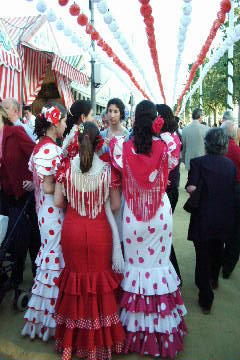 ebration dating back a couple hundred years, the women all dress up in
“flamenco” dresses, put a huge flower in their hair and go to the feria to see
and be seen in the latest fashions. This year’s dresses feature huge polka
dots and are tightly fitted down to about mid-thigh where the skirt flares out
into a profusion of ruffles, creating a graceful silhouette a bit like a
champagne glass inverted. The teen-aged girls look especially beautiful, the
dresses flattering their thin figures, with fancy combs and flowers in their
hair. The fair grounds are fitted out with many “casetas”, this year
numbering somewhere around 300. Each caseta, starting out as a tent, is
elaborately decorated with fabric and lace, flowers and paintings, paper
lanterns with tiny lights inside, tables and chairs plus a sound system and a
dance floor to dance the traditional “Sevillanas”. The streets of the
fairgrounds are packed with people as are the public casetas; in Sevilla, 95%
of the casetas cannot be entered by the public as they are sponsored by
wealthy people or businesses and admit people by invitation only. Those who
have no invitations must squeeze into one of the municipal casetas where they
can buy a glass of manzanilla (dry sherry), some fried fish or fried peppers,
or a rebujito, a traditional drink for feria which is manzanilla cut with some
7-up.
ebration dating back a couple hundred years, the women all dress up in
“flamenco” dresses, put a huge flower in their hair and go to the feria to see
and be seen in the latest fashions. This year’s dresses feature huge polka
dots and are tightly fitted down to about mid-thigh where the skirt flares out
into a profusion of ruffles, creating a graceful silhouette a bit like a
champagne glass inverted. The teen-aged girls look especially beautiful, the
dresses flattering their thin figures, with fancy combs and flowers in their
hair. The fair grounds are fitted out with many “casetas”, this year
numbering somewhere around 300. Each caseta, starting out as a tent, is
elaborately decorated with fabric and lace, flowers and paintings, paper
lanterns with tiny lights inside, tables and chairs plus a sound system and a
dance floor to dance the traditional “Sevillanas”. The streets of the
fairgrounds are packed with people as are the public casetas; in Sevilla, 95%
of the casetas cannot be entered by the public as they are sponsored by
wealthy people or businesses and admit people by invitation only. Those who
have no invitations must squeeze into one of the municipal casetas where they
can buy a glass of manzanilla (dry sherry), some fried fish or fried peppers,
or a rebujito, a traditional drink for feria which is manzanilla cut with some
7-up.
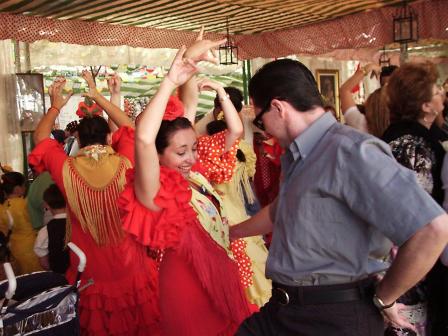
It all started on a Monday night at midnight, when they officially opened the
feria by turning on the thousands of light bulbs that decorated the gateway to
the fairgrounds. Every afternoon you could see nicely dresses people strolling
through town on their way to feria; gorgeously dressed women in ruffles, men
in suits, baby girls pushed in strollers framed by the ruffles of their
dresses. Those who could, would hire a horse and carriage and ride in style,
glass of manzanilla already in hand. Sometimes in the mornings on the way to
school I would see people just coming home from feria. Needless to say, not
much work gets done during this week and the shops all close in the afternoon.
 Next Page