May 25, 2003
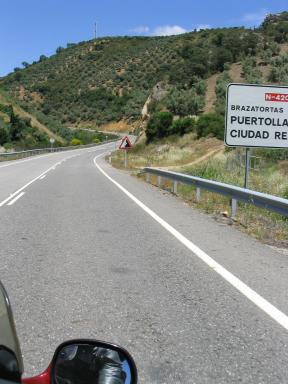 Sunday morning, leaving Sevilla. I am sad to leave our
apartment but Mike is anxious to do some riding and we have new adventures
ahead. We had arranged 5 nights in 5 different paradors and were looking
forward to staying in them. One last quick check of e-mails, café con leche and
tostada for breakfast and we are on the road early, afraid that the sun will get
too hot for comfort.
Sunday morning, leaving Sevilla. I am sad to leave our
apartment but Mike is anxious to do some riding and we have new adventures
ahead. We had arranged 5 nights in 5 different paradors and were looking
forward to staying in them. One last quick check of e-mails, café con leche and
tostada for breakfast and we are on the road early, afraid that the sun will get
too hot for comfort.
It is cooler than usual though, and soon we are riding through a landscape of
rolling hills and fields of grain as far as the eye can see. There are fields of
sunflowers, too, some starting to bloom already and groves of olive trees
polka-dotting the landscape. After passing Cordoba, we started north to ride
through a wilder area, with pine trees and rocky hills. Scents of pine and
lavender and beeswax fill the air as it gets cooler, cool enough for us to stop
and dig our heated liners out of our bags and put them on. The road has few cars
on it but nonetheless, a police car appears from nowhere to ask if we need any
help.
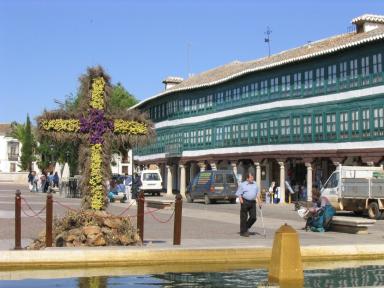 Our lodging for the evening was the parador in a town
called Almagro, south of Madrid. Almagro turned out to be a sleepy small town of
typically Spanish stone houses with graying whitewashed walls and an assortment
of churches. We walked into town to look around and discovered a Plaza Mayor,
the main square, left over from the middle ages with its columned arcades and
living quarters in the two upper stories, the windows surrounded by wooden
lintels painted dark green. The ground floor was populated with bars,
restaurants, and shops with hand-made bobbin lace as the town is an old lace
center; women still bring their home-made lace in to the numerous lace shops to
be sold. I admired the lace and the lacemaking tools for sale there and bought a
couple of ornate hand-carved bobbins for my collection. A recently restored
theater was open for a visit so we wandered in and found ourselves in a quaint
little auditorium that could have been contemporary of Shakespeare. Some actors
were practicing a scene from a play and we sat in one of the upper galleries
enjoying the antique ambience, the low overheads, the oil lamps. We went into a
shop selling local specialties and bought a bottle of the local wine to try, at
4 euros. Another local specialty seems to be small eggplants, colorless from
being pickled in some sort of brine, and canned in either glass jars or in
dented metal cans. We decided to pass on trying them.
Our lodging for the evening was the parador in a town
called Almagro, south of Madrid. Almagro turned out to be a sleepy small town of
typically Spanish stone houses with graying whitewashed walls and an assortment
of churches. We walked into town to look around and discovered a Plaza Mayor,
the main square, left over from the middle ages with its columned arcades and
living quarters in the two upper stories, the windows surrounded by wooden
lintels painted dark green. The ground floor was populated with bars,
restaurants, and shops with hand-made bobbin lace as the town is an old lace
center; women still bring their home-made lace in to the numerous lace shops to
be sold. I admired the lace and the lacemaking tools for sale there and bought a
couple of ornate hand-carved bobbins for my collection. A recently restored
theater was open for a visit so we wandered in and found ourselves in a quaint
little auditorium that could have been contemporary of Shakespeare. Some actors
were practicing a scene from a play and we sat in one of the upper galleries
enjoying the antique ambience, the low overheads, the oil lamps. We went into a
shop selling local specialties and bought a bottle of the local wine to try, at
4 euros. Another local specialty seems to be small eggplants, colorless from
being pickled in some sort of brine, and canned in either glass jars or in
dented metal cans. We decided to pass on trying them.
The parador was built in the 16th century as a
Franciscan convent with the rooms arranged around 4 quiet courtyards. The room
we had was nicely furnished,
TV, mini-bar and marble bathroom. Surely nicer than
anything the nuns had in the old days! We wandered around the grounds and found
a bar and ordered some cafés con leche and a local specialty called Migas. Migas
turned out to be and interesting peasant dish of fried breadcrumbs with garlic
and small bits of bacon in it. The seating area inside the bar had three or four
large terra-cotta objects in a row that looked like large wells with wooden
covers four feet across. When we asked what they were, the bartender said they
were called Tinajas and invited us to go down the stairs to see the rest of it.
The tinajas turned out to be enormous amphorae, straight out of Greek or Roman
times; oval shaped body with a point at the bottom, a wide body tapering to a
small opening. These amphorae were tall enough to rest its pointed end on the
floor of the lower story and the mouth to protrude about 3 feet above the level
of the upper floor. They were once used for storing wine and now, the bartender
joked, they put bad customers in them…(Oh Ha, Ha!)
We walked back into town with an American
couple we met at the parador; from Chicago, they are also avid bikers and
travelers and we found much in common. They had hoped to travel to China
this year, but just after they had booked their trip the news of the SARS virus
broke and they quickly changed their plans. We had shared conversation and our
cheap bottle of wine with them; the wine turned out to be drinkable although not
destined to be one of the great wines of the world. We decided to go to get some
dinner together at 9pm before the restaurants closed for the evening, noting
that the restaurant hours are much earlier here than in Sevilla. Upon reaching
the plaza mayor we were surrounded by a group of pre-teen girls holding water
balloons and seeming almost frantic for attention; Mike tried to communicate
with them in Spanish while they all swarmed around him shouting at the same time
trying to be heard above the shouts of their friends. Dinner turned out to be a
bit disappointing and was more expensive than we expected, much more than it
would have cost in Andalucia.
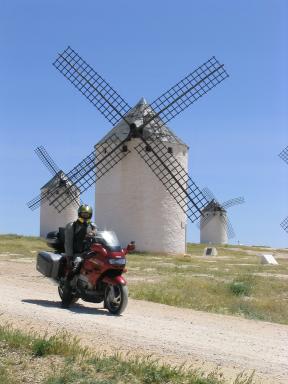 The next morning on the advice of the people
at the parador, we headed out across a vast flat plain with ripening grain with
a steady wind to keep us alert. The road rose gradually until we found ourselves
in a town called Campo Del Griptana set on a ridge crowned with about a dozen
old windmills straight out of Don Quixote; white-washed round stone towers
topped with a conical roof and the framework of four wind blades missing their
canvas covering. The steady wind on the hill certainly justified the existence
of the mills. The ride was pleasant, if on the cool side, but the sun was
shining and we always had our heated gear if need be.
The next morning on the advice of the people
at the parador, we headed out across a vast flat plain with ripening grain with
a steady wind to keep us alert. The road rose gradually until we found ourselves
in a town called Campo Del Griptana set on a ridge crowned with about a dozen
old windmills straight out of Don Quixote; white-washed round stone towers
topped with a conical roof and the framework of four wind blades missing their
canvas covering. The steady wind on the hill certainly justified the existence
of the mills. The ride was pleasant, if on the cool side, but the sun was
shining and we always had our heated gear if need be.
The parador for the next night was in Cuenca
east of Madrid, and was another 16th century convent set on a rocky
peak above a gorge. Larger than the convent in Almagro, it has a large sunny
courtyard surrounded by arched cloisters on all four sides and a maze of
corridors leading to the rooms (Mike jokingly asked if there was a map to our
room). Our room, nicely furnished as you would expect, had a lovely view of a
farm way down in the bottom of the gorge and a wall of stone facing our window.
On the other side of the gorge, and dwarfing the convent is the old town of
Cuenca, built on a high cliff of buff-colored rock. Its houses and churches are
built of the same color stone, right up to the edge of the cliff giving them the
appearance of having grown there out of the rock itself. Some charming houses
built in the middle ages have balconies that jut out over the gorge, justifying
the name of “the hanging houses” and are a symbol of the town. We walked across
a narrow metal pedestrian bridge that links the parador to the town and
discovered that the city is built on a narrow wedge of land with deep gorges on
either side, the remains of a once Moorish castle at one end to defend the city
The staff at the parador gave me a very interesting little
booklet with the history of the parador and the town. It is a jumble of wars and
rebellions, successive waves of peoples who overcame by force and settled there
only to be replaced. It had been populated in the Neolithic times, and the
Romans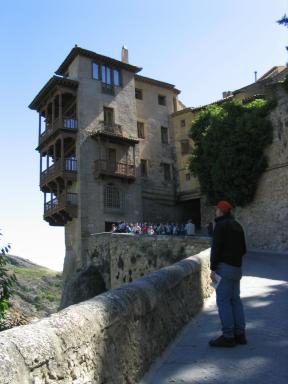 recorded that there had been Celtic peoples there before them. The keep of the
Arab castle was converted by the Christians into the first prison the serve the
Holy Inquisition. Napoleon’s troops destroyed the town by fire during a French
invasion because of the resistance of the rebellious population.
recorded that there had been Celtic peoples there before them. The keep of the
Arab castle was converted by the Christians into the first prison the serve the
Holy Inquisition. Napoleon’s troops destroyed the town by fire during a French
invasion because of the resistance of the rebellious population.
We went down to the bar for some coffee at the parador
after our walk, so that Mike could work on e-mails, then we went back to the
room to get our jackets to walk into town for dinner. As we passed the bar on
the way out, the bartender called to us and motioned for us to come back. He
asked if the bike outside belonged to us and when we said yes, he excitedly said
(in Spanish), you won’t believe this, but I also own a GTS! Now, if you knew
that there were only about 2000 GTS’s ever made, you would understand how
incredible it is that we keep running into people who own them...He and Mike
spent a happy hour talking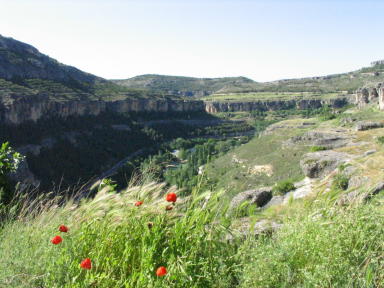 about the bike and their experiences and exchanged
e-mail addresses promising to keep in touch.
about the bike and their experiences and exchanged
e-mail addresses promising to keep in touch.
In the morning I went back to the bridge, to take some more
pictures in the morning sun. Mike stayed behind on solid ground because the
sheer height of the bridge and the seemingly flimsy wooden planks of the bridge
made him too nervous to cross one more time!
Previous Page
 Next Page