May 27, 2003
Leaving the parador at Cuenca, we drove along the river at
the bottom of the gorge, a beautiful leafy green drive. We took a winding road
with little traffic up into the mountains with beautiful panoramas of green
fields of grain and red brick soil. We were getting low on gasoline though, and
there weren’t very many villages on this section of road. One village we went
through had no gas at all so we followed signs to a place called Enchanted City.
It turned out to not to be a city at all, but an interesting area with huge
square blocks of stone laying here and there on the ground and with a good sense
of imagination one could imagine a city turned to stone. Two men were standing
by a small snack bar by an admission gate so we asked them where we could get
gas. We had to go back to Cuenca, they said, and just before you get there,
there is a village with a gas station. Showing us on the map where we were, we
realized that we had taken the wrong road out of Cuenca anyway, so we turned
back to find gas. No problem, it was a beautiful day, a beautiful road and the
ride was worth it. That’s why we’re out here anyway, isn’t it?
The rest of the drive was pleasant too, through narrow
piney gorges, astonishingly red soil and stone cliffs, and a succession of small
villages. Most of the villages had benches in the shade facing the only road in
town, where a few old men would be sitting, chatting, watching the cars go by or
drowsing in the warm afternoon. We stopped in one such town, where an old woman
in a bar made some enormous sandwiches for us; we took them across the street to
a small park commemorating the Spanish armada to eat. Getting back on the bike
after finishing our lunch, I saw the old woman slip out of the bar to resume her
spot on the bench…
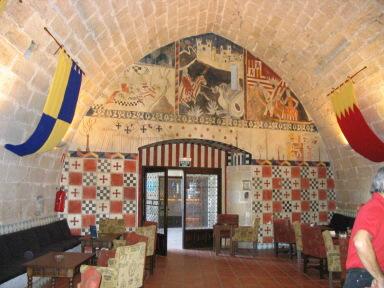 The
parador in Alcañiz was formerly a small, somewhat plain castle on a hill dating
from the 12th century with a façade built in the 18th
century. In the last 8 centuries it had been used as a home, a convent,
barracks, a prison and finally a ruin before being restored and made habitable
again as a luxury hotel. We explored the grounds, what there was of it; stairs
that went nowhere, a fresco’d façade of a church in the process of being
restored, the outer defensive wall. The bar was in a charming vaulted room with
a fresco on one wall depicting medieval life. We had a spectacular view of the
countryside stretching out below us, fields grain and red-roofed villages. We
ate at the restaurant in the parador that night and chose from a menu of
regional dishes that were beautifully prepared.
The
parador in Alcañiz was formerly a small, somewhat plain castle on a hill dating
from the 12th century with a façade built in the 18th
century. In the last 8 centuries it had been used as a home, a convent,
barracks, a prison and finally a ruin before being restored and made habitable
again as a luxury hotel. We explored the grounds, what there was of it; stairs
that went nowhere, a fresco’d façade of a church in the process of being
restored, the outer defensive wall. The bar was in a charming vaulted room with
a fresco on one wall depicting medieval life. We had a spectacular view of the
countryside stretching out below us, fields grain and red-roofed villages. We
ate at the restaurant in the parador that night and chose from a menu of
regional dishes that were beautifully prepared.
The road to the next parador, outside the town of Vic in
the heart of Cataluña, took us through more of the pleasant countryside. Soon we
met the river Ebro, dammed to create a long winding lake in the mountains, in an
otherwise dry area with sparse pine trees and sage-like ground cover. In the
slopes between hills, where there was enough soil to support a tree, we started
to see small groves of fruit trees, mostly peaches and cherries. After Lleida we
hit the highway, a straight road through a warm and humid industrial area –
we’re about 100 kilometers west of Barcelona at this point. I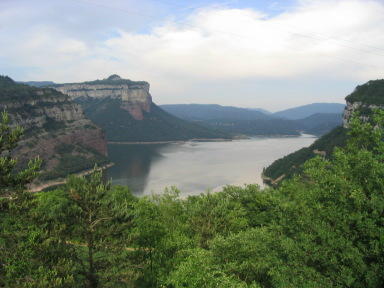 kept my eyes peeled for the road we were to take so we could leave the highway –
Mike was getting bored – but our map didn’t show the number of the road so we
ended up overshooting the exit we wanted.
kept my eyes peeled for the road we were to take so we could leave the highway –
Mike was getting bored – but our map didn’t show the number of the road so we
ended up overshooting the exit we wanted.
Luckily, there was another exit in a
few more miles that would take us to the road we wanted and soon we were
twisting up a hill between golden fields of grain thick with red poppies. Huge
traditional stone farmhouses perched on hillsides overlooking the fields, some
large enough to house a small village. We passed through the town of Vic and
soon found ourselves in a forest, feeling more remote than I have ever felt in
Spain.
The parador sits on a spit of land above a reservoir in the middle of
nowhere, and the only sounds are the songs of thousands of birds and the
occasional car on its way to the parador. The building itself is a modern one,
built in the style of a traditional Catalan Masia or farmhouse. We had a lovely
cup of coffee on the deck overlooking the lake, hearing nothing but birdsong,
and in the evening had another wonderful meal at the parador since we were so
remote from any town. Of the five paradors we stayed in this trip, this was by
far our favorite one. The picture to the right is a view of the lake from the
parador. We have been told that in the summer,
when the water level is low, one can take a boat out into the lake and see a
submerged village, flooded when the dam was built. If the water is low enough
they say, you can see the steeple of the church sticking out of the water...
The next night was in the parador of Cardona, another
castle in the foothills of the Pyrenees. It was a short ride, only 60 miles from
the parador at Vic so we arrived early and took the bike down to explore the
town. Buildings of dark grey stone line steep gloomy streets of dark grey paving
stones, with shops on the street level. Some people are out, shopping or
chatting in Catalan but otherwise the town is quiet. Aside from a few
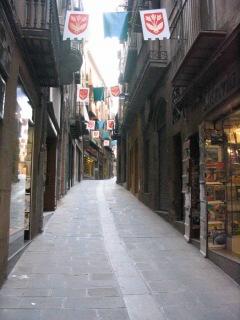 small grocery stores, a baker, a
butcher, the newspaper/tobacconist and a store selling matronly women’s
clothing, there is not much for a window shopper to look at. We returned to the
castle after lunch and looked around the castle which was a bit more
interesting.
small grocery stores, a baker, a
butcher, the newspaper/tobacconist and a store selling matronly women’s
clothing, there is not much for a window shopper to look at. We returned to the
castle after lunch and looked around the castle which was a bit more
interesting.
The castle sits on top of a hill with the town spread down
the side of the hill outside the walls. It is a proper fortified castle, bigger
than the castle in Alcañiz, with towers and crenellations and lookout towers
with narrow slits for shooting arrows through, perfect for sparking the
imaginations of the three English children running back and forth imagining
themselves to be knights of the round table. Our room was a dark, high-ceilinged
cave of a room, the single window set about 12 feet off the floor. The earliest
phase of construction at the castle was a small, half demolished watch-tower
from the second century. The castle was fortified in the 9th century
and from there, the castle’s evolution continued for the next 4 or 5 centuries.
I climbed up to the top of the watchtower to get a great view of the valley, the
town below and a mountain of salt which has been mined since the 2nd
century A.D. yielding white and rose colored stones of salt crystal.
After leaving Cardona, we continued north to spend a couple
of days in Andorra, a tiny principality in the Pyrenees wedged between Spain and
France. It’s a rocky, mountainous country with two principal roads jammed with
traffic through the towns. Where there is enough soil to support a crop, we saw
freshly planted tobacco seedlings or green pastures with cows. While the
principal language of Andorra is Catalan, Spanish and French are also spoken.
Lots of foreigners go to Andorra for skiing in the winter, but the main reason
to go there in the summer is for duty free stuff like cigarettes, alcohol,
perfume, cameras, watches, etc…not to mention the motorcycle shops; you can get
all kinds of bike stuff from helmets and gloves to an oil change and parts for
very competitive prices.
 We spent
most of a day going from one shop to another looking for some new leathers for
Mike. We were marginally successful; we found the perfect leather jacket with
lots of zippered vents but, typically, they didn’t have one in his size. We’ll
look them up on the internet later and try to get it that way. We wanted to take
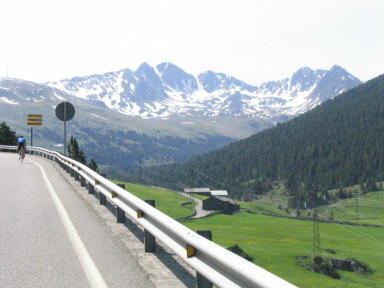
a ride up high into the skiing area but as we headed out of town it
started to rain, big warm drops of water so we ducked into a covered gas station
to wait it out. The shower soon tapered off so we headed out and were soon
riding through pastureland spotted with white narcissus and yellow daffodils (on
the first of June, daffodils?!).
We spent
most of a day going from one shop to another looking for some new leathers for
Mike. We were marginally successful; we found the perfect leather jacket with
lots of zippered vents but, typically, they didn’t have one in his size. We’ll
look them up on the internet later and try to get it that way. We wanted to take
a ride up high into the skiing area but as we headed out of town it
started to rain, big warm drops of water so we ducked into a covered gas station
to wait it out. The shower soon tapered off so we headed out and were soon
riding through pastureland spotted with white narcissus and yellow daffodils (on
the first of June, daffodils?!).
Our hotel was in Soldeu, a small ski town not too far from
the French border. The hotel had a nice heated pool, but when we decided to swim
in it, we were first required to rent towels and take a shower. Fine, no
problem, but as soon as we stuck one foot in the water we were informed that if
we wanted to swim we were required by Andorran law to buy a swim cap and cover
our hair.
We stopped at an Indian restaurant one night for dinner,
and were startled to be greeted by a young woman saying (in English), “Ready for
a spot of curry then, are you?”. Chatting with her and other English people
dining there, we learned that many English people go to Andorra for skiing and
there is a small enclave of English people living in Soldeu.
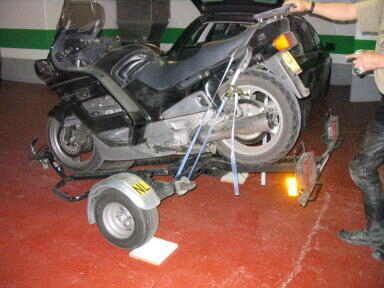 We
met some Dutch bikers in the garage of the hotel, who had trailered their bikes
to Andorra on ingenious little motorcycle trailers invented, they said proudly,
by a Dutchman. Little more than a frame with space for one motorcycle, it sits
flat on the ground so that one person can easily roll a bike onto it. Once the
bike is on and strapped down, a hydraulic pump gradually jacks the wheel axels
up off the ground and you are then ready to go. (www.vanvossen.nl
for the website…). Once at home, the trailer can be folded and stored.
We
met some Dutch bikers in the garage of the hotel, who had trailered their bikes
to Andorra on ingenious little motorcycle trailers invented, they said proudly,
by a Dutchman. Little more than a frame with space for one motorcycle, it sits
flat on the ground so that one person can easily roll a bike onto it. Once the
bike is on and strapped down, a hydraulic pump gradually jacks the wheel axels
up off the ground and you are then ready to go. (www.vanvossen.nl
for the website…). Once at home, the trailer can be folded and stored.
The next evening, going to dinner, we were driving along
with a car on our tail. Mike kept trying to lose him, but the driver was
evidently determined. As we pulled into the parking lot of the restaurant, the
car pulled in too, and the people inside rolled down their windows, saying
“Mike, is that you??”. It turned out to be a guy Mike had met years ago that
lives in Andorra and had once had a GTS too. It is incredible how small the
world is sometimes!
Previous Page
 Next Page