June 11, 2003
We have been in southern France now for 10 days and we are
having a bit of culture shock. Not to mention sticker shock! At the moment we
are in the Massif Central, located somewhere south-central part of France, in a
fascinating and beautiful region of volcanoes and green pastures… it is
amazingly hot, 42 degrees Celsius in the shade and very humid. (38C is equal to 100F,
so 42C is, um, well, Very hot!). My hair is damp from sweat inside my helmet, my
arms slick inside my jacket sleeves and my leather pants feel like they are
melting in the heat onto my legs. I find myself fantasizing about a Grande, no
make that a Venti, iced mocha Frappuccino from Starbucks, beads of icy
condensation dripping down the side of….Sorry! got a little sidetracked…
As I said we’re in a bit of a state of longing for Spain;
while we enjoy France, we miss the cheap prices for everything and being able to
eat as late as you wish. For example, a dinner for both of us in Spain including
a bottle of wine would average 15 to 25 Euros, and a café con leche,
€ .90. You
can eat later in the day in Spain, where you would have no trouble finding food
as late as 11:30-12:00 at night. Here, in France, often you have to order your
dinner between 7:30 and 8:30 or else you will get nothing because everything
closes in the evening. This may not seem like a big deal but when you are
traveling, your normal routine and mealtimes often get thrown off track and
these small windows of time when you can eat makes it a little difficult
sometimes. Dinner, chosen off a set menu costs around €15
per person with another €10
thrown in for wine. The fixed price set menu is typically French; you have 2 or
3 choices for a starter, usually 3 choices for a main course dish and a 2 or 3
choices for a dessert. Coffee, though is the real contrast. Since coming back to
France, we have been paying an average of €2.20. The
other day, we stopped in a town for a well deserved rest and a cup of coffee and
was shocked to learn that they wanted €3.50 for it!
The traveling life has its drawbacks too; like the
chambermaid knocking on your door at 9AM, waiting to make up the room in spite
of the do not disturb sign on the door, the bath towels size of a small hand
towel, the hard beds and strange pillows. In France, for some reason, they
prefer what Mike and I call a sausage pillow. It is a small, round bolster that
goes all the way across the bed. If I try to sleep on it, I spend the next day
with my head bent at an unnatural angle. If you try to remove it from the bed
you find that the pillow has been rolled up in the top of the sheet instead of
using a pillowcase, so you end up un-making the bed! Luckily, you can usually
get someone at the front desk to find you one or two “normal” pillows. In
France, a large bed is usually what an American would consider a somewhat small
“double-sized” bed, but Spain, a “matrimonial” bed is normally 2 narrow
twin-sized beds made up separately and shoved together.
I don’t want to leave the impression that I am complaining
about all of this. Of course, there are many things to make up for the
discomforts of traveling; the people you meet, the beautiful countryside, the
different foods and cultures, riding on twisty roads on a motorcycle.
Another fact of life in France is that at any given time
there will probably be some group of workers on strike. The French word for
strike is Greve and we're getting to know the word very well! At the moment
there is a huge strike going on all over the country, and has been going on for
at least a month. The country is in an uproar because the French government is
planning on pension policy changes and the result is massive protests and work
stoppages by civil servants. As we ride through towns we see bags of garbage in
piles by the side of the road waiting for pickup. In Carcassonne, the post
office doors were open and the workers present but with arms crossed, refusing
any transactions. La petit tren, a tourist train that takes a scenic trip
through lovely country in the South of France, was also on strike. A hospital
with a banner declaring it to be on strike and ambulance drivers, libraries,
teachers and museums are also affected in a rotating basis. The Fermeture
Exceptionelle, an unexpected closure of a shop or restaurant, is getting to be
familiar to us as well. Occasionally, a shop will close its door for a reason as
simple as fatigue of the shopkeeper. The motorcycle shop's parts department was
closed one day because the guy running the counter had tests that day...In the
U.S., there would probably be another person there to cover but that is rare in
France, with their labor laws, the 35 hour work week and the high cost of
employees.
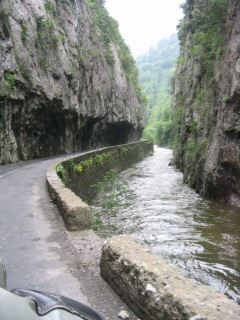 Once
we had left Andorra, we descended into France on beautiful, winding roads
through the forest and narrow gorges and came into a town called Quillan. We had
met a couple from Britain several years ago when traveling through Chiapas.
After their trip to Mexico, they bought a house here in Quillan and we were
curious to see if they were still there. They were, having fixed up the house
and turned it into a Bed and Breakfast. The house is right next to the river
Aude, shaded by the cottonwood trees lining the river, and is filled with the
soothing sound of rushing water.
Once
we had left Andorra, we descended into France on beautiful, winding roads
through the forest and narrow gorges and came into a town called Quillan. We had
met a couple from Britain several years ago when traveling through Chiapas.
After their trip to Mexico, they bought a house here in Quillan and we were
curious to see if they were still there. They were, having fixed up the house
and turned it into a Bed and Breakfast. The house is right next to the river
Aude, shaded by the cottonwood trees lining the river, and is filled with the
soothing sound of rushing water.
While drinking a cup of tea with our friends, the sky
started to darken and thunder rolled down out of the mountains. A breeze came up
and the drifting bits of cotton from the cottonwood trees floated through the
air and into the room as we talked about what we had been up to for the last few
years since we saw them. We had seen the house when they first bought it, a dark
wreck of a house empty for years; it is now a charming place, bright and
comfortable. They had bought a couple other houses in town as well to fix up and
seemed to be quite happy there. As we are learning, their story is not so
unusual these days, as many foreigners, especially the British and the Dutch,
are buying houses in these small villages and renovating them to live in part-
or full time. Some of these small villages were slowly dying out as the young
people move away to find jobs and the older people die off; it remains to be
seen how the culture of these places, which drew the foreigners here in the
first place, will change as they start to outnumber the French locals…
The above photo shows a gorge was so narrow that the road
builders had to undercut the rock wall in order gain enough space to put two
lanes of traffic. However, if the oncoming traffic happens to be a bus or a
tourist driving an RV, you'd best believe they don't treat this road as two
lanes, but are more likely to be in your lane!
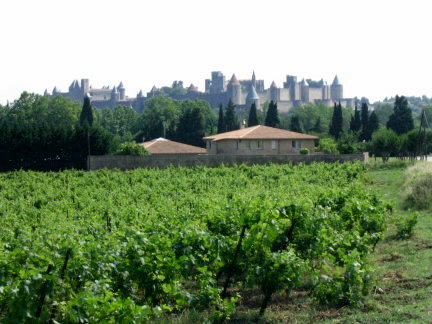 After leaving
Quillan, we found a hotel in Carcassonne to stay for a few days and do some day
rides through the area. The fortified city with its numerous towers set on top
of a high cliff looks like a fantasy city straight out of a book of fairy tales.
It is an incredibly picturesque and unique place that remains pretty much as it
was in the 13th century and as such, is usually full of tourists. Its
cone capped towers with pennants streaming in the breeze are visible for long
distances; an intensive renovation project was supposedly funded by Napoleon to
restore the city making it look fresh and newly built. In fact, some of the
walls are about two thousand years old, built by the Romans and added on to
throughout the centuries. The last set of construction was done in the 13th
century, when the cannon was invented, making fortresses like this obsolete.
After leaving
Quillan, we found a hotel in Carcassonne to stay for a few days and do some day
rides through the area. The fortified city with its numerous towers set on top
of a high cliff looks like a fantasy city straight out of a book of fairy tales.
It is an incredibly picturesque and unique place that remains pretty much as it
was in the 13th century and as such, is usually full of tourists. Its
cone capped towers with pennants streaming in the breeze are visible for long
distances; an intensive renovation project was supposedly funded by Napoleon to
restore the city making it look fresh and newly built. In fact, some of the
walls are about two thousand years old, built by the Romans and added on to
throughout the centuries. The last set of construction was done in the 13th
century, when the cannon was invented, making fortresses like this obsolete.
Another section of the city of Carcassonne is called La
Bastide, where the locals hang out, sipping coffee in the square, going to the
market or conducting business. It is a very quiet place, except for July and
August when all the tourists are in town and it becomes quite lively for 2
months. We had heard of a hotel nearby which offers free indoor parking for
motorcycles but when we got there it was closed. Fermeture Exceptionelle, a sign
on the door said, closed until the 3rd of march. Huh?! A few days later
we went back and the hotel had reopened; the woman explained that she was tired
and decided to close the hotel for a few days. So tired in fact that she didn’t
notice that she had put the wrong month on the sign…We were shocked one day when
we asked for a salad for lunch and were told that lunch was over at 1:30 (it was
1:40 in the afternoon) and we’d have to go to the bakery for a sandwich if we
wanted food.
In the mornings we would walk to the square to get some
coffee and croissants for breakfast where we met a British man who bought a
house just outside of town. He told us that Ryan Air recently started offering
flights from Britain to Southern France for very low prices, making this area
very attractive to vacationers and prospective home-buyers. Looking around, we
could see that there were indeed a lot more tourists and non-French people
around than is usual for this time of year.
Mike had some work he wanted to do and needed a high speed
internet connection, so one evening, we decided to go into La Bastide to the
internet site at 10pm. Even though it wasn’t that late, the front door of the
hotel was locked! We had been given a code to open the door from the outside but
in order to get out, we had to hunt down the manager to get him to turn the
alarm system off and unlock the door. The manager seemed a bit grumpy at being
rousted so late and incredulous that we would want to go out at such an hour! I
tried not to think of what would happen in case of an emergency at night…It had
been raining a bit during the day but now the air was fresh and the streets dry
so we set off to the internet place.
After Mike finished his work,
we walked around a little bit then decided to go back to the hotel since there
was nothing open except bars serving only alcohol, when suddenly, it started
raining and we had to run for the shelter of an awning. The rain kept coming
down harder and harder so we ran across the street where a bank had a foyer with
ATM machines and stood behind the glass watching the rain. After a few minutes,
we watched the gutters become rivers, then disappear under the water, the roads
becoming streams then a rushing river. The sidewalk where we had taken refuge
under the awning was now also under water but the bank where we stood behind now
steamed-up windows, was still safe high territory. Little by little, the rain
storm gradually tapered off and after another 20 minutes or so, the water had
receded and we were able to leave our sanctuary and head back to the hotel.
The countryside around Carcassonne is pleasant, with gently
rolling hills covered by orderly rows of grapevines as far as the eye can see.
Scrubby trees and low plants appear where the ground is too rocky to plant
grapes. Pre-historic man lived in these valleys as well, and left cave paintings
as evidence they had been there long ago. Looking out over the vines, I
sometimes think that the grapes will never end and it boggles my mind to think
of the vast amount of wine produced in this area. The grapes here turn out to be
a lower quality and make a wine that is much less prestigious than other regions
in France, such as Bordeaux for example. The south of France has a character
that is unlike the north; part French, part Spanish, part something all its own.
We find that many people speak Spanish here, so if we run into trouble
communicating we can often get by using some Spanish. The local dialect is
Catalan or Occitan which sounds to me like a mixture of French and Spanish. We
stopped in a little town for a break and something to drink and Mike saw a wine
shop, so he went to check out the local wines. Mike was totally charmed by the
two old women in the shop, when asked if they spoke Spanish, the shopkeeper
said, “no, Catalan.” Glancing at her companion for confirmation, the second
woman also said, “no, Catalan.”, nodding to each other with a smug smile. We bought a few bottles of wine there, including
a pretty good Cabernet/Merlot mix for only 3 Euros…
One of the day trips we took was a ride to Narbonne, an
important town in the Roman times. It is a pleasant city with a canal running
through it, lined with trees and flowers; a 13th century cathedral
and archbishop’s palace stand near a square across from modern supermarkets. A
small section of the Via Domitia, an important roman road which linked Rome and
Spain runs through the middle of the square. We had come here to see what was
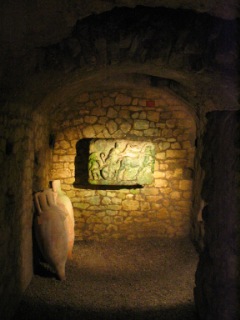
left of Narbonne in the Roman times so we went to see the Horreum, an ancient
underground warehouse. As we descended the stairs into the warehouse, we could
feel the temperature drop drastically as if air conditioned. A series of
corridors stretched out before us lined with small barrel-vaulted chambers on
either side, barely tall enough to stand up in. Some were equipped with empty
amphorae or a display of carved stones that had once graced a Roman building.
The small cubicles had once held goods for sale in the market above the Horreum;
pottery, cloth, olives, wine, casks of oil, etc. Not all of the Horreum has been
excavated, but it amazed me that any of it existed still at all!
The canal I mentioned earlier was originally dug by the
Romans; they made Narbonne into a major port city even though the city was about
3 kilometers from the sea. Many interesting artifacts were dredged from the
canal and housed in the Musee Lapidaire, Our map showed that it was in a small
church not far away. We found it easily and drove around it a couple of times to
try to figure out how to get into it, when we finally noticed a small locked
wooden door with a small sign with the hours, stating that it was open on
Wednesdays only. We looked at each other to confirm that it was indeed Wednesday
today and according to the sign, it should be open. We went into a nearby shop
to see if they knew anything about it and they just shrugged their shoulders and
said, I know nothing about it, perhaps they’re on strike…
Leaving Carcassonne, we rode east for a bit but it was
getting so hot that the riding was not much fun in spite of the nice
countryside. We ended up staying a night in Nimes, in a hotel room on the edge
of town. The main attraction of this hotel room was the air conditioning which
we promptly turned on full blast and didn’t leave the room until it was almost
dark. As I mentioned at the beginning of this story, it was quite hot that day,
and even at 10pm, was still sweaty-hot. One of Nime’s big festivals is the Feria,
similar to the Ferias of south Spain complete with bull fights and Sevillanas!
The difference in France is that the bull doesn’t get killed; instead, after
teasing the bull a while, the bullfighter tries to snatch a ribbon cockade the
bull wears between his horns – preferably without getting gored. I hate to say
it, but we didn’t go into town to brave the crowds of people to check out the
feria, it was still so hot and we wanted to get an early start to head for the
mountains and cooler temperatures.
Previous Page
 Next Page