June 16, 2003
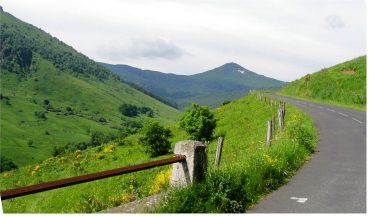 We
spent some time in Auvergne, a lovely area that had once been the center of
intense volcanic activity. A chain of maybe 25 volcanoes stand in a row, cone
shaped and covered with green grassy meadows. Subsequent glaciers eroded the
lava flows and cones into more gentle shapes. Many of the peaks, called Puys by
the locals, rise abruptly into the air as if someone had taken a pinch of green
velvet and pulled it into a peak. Other puys have an indented crater at the top
as if a giant had put his thumb print on the peak. The tallest of them is called
Puy-de-Dome, and is crowned with a modern telecommunications and meteorological
center and the remains of a 1st century Roman temple to Mercury. At
the top, we had a breath-taking view of nearby hills covered in lush green
pastures and wild-flowers in every color you could imagine. An information
center has story boards showing the fascinating geological story of the area.
We
spent some time in Auvergne, a lovely area that had once been the center of
intense volcanic activity. A chain of maybe 25 volcanoes stand in a row, cone
shaped and covered with green grassy meadows. Subsequent glaciers eroded the
lava flows and cones into more gentle shapes. Many of the peaks, called Puys by
the locals, rise abruptly into the air as if someone had taken a pinch of green
velvet and pulled it into a peak. Other puys have an indented crater at the top
as if a giant had put his thumb print on the peak. The tallest of them is called
Puy-de-Dome, and is crowned with a modern telecommunications and meteorological
center and the remains of a 1st century Roman temple to Mercury. At
the top, we had a breath-taking view of nearby hills covered in lush green
pastures and wild-flowers in every color you could imagine. An information
center has story boards showing the fascinating geological story of the area.
We stayed for a few days in a town called Murat. It is an
old town of medieval grey stone houses roofed with flat stones shaped by hand
into scalloped shingles. Here we were able to try some of the local foods and
drinks. Salers, named after the town of the same name, is a golden-yellow
aperitif which is sweet and bitter, made from a yellow gentian flower that grows
here. Aligot is a local cheese and is prepared by mixing pieces of cheese into
hot mashed potatoes, left to melt then seasoned with garlic and the juice from
grilled sausages. The resulting dish is also called Aligot and is like flavorful
but chewy mashed potatos – melted aligot cheese can stretch six to ten feet when
pulled with a spatula! It’s just the sort of dish I imagine was a favorite of
generations of Avergne children. Truffade is another cheese and potato dish, but
instead of potato puree, it’s made with chopped potatos, then fried. Pork dishes
are common, like the boiled pork with cabbage called Potee, or the Auvergne-style
cured hams. Pounti is a sort of light, fluffy meatloaf with bits of cured ham,
pork breast, prunes and beet leaves. This region is also famous for a green
lentil that has been farmed here since Roman times. They say that the volcanic
soil gives the lentils a very special flavor. And for dessert, once could choose
a tart made from wild blueberries or a walnut cake…
On a day trip exploring the area we took a nice ride that
took us through a gorge that opened up into a reservoir of water. The Viaduct du
Garabit spanning the gorge was designed by Eiffel; the lofty metal arch of the
viaduct with its lacy framework is typical of his work. Small roads meandered
their way through leafy forests and past lakes and streams. We came to a small
town where we saw a group of bikes parked and we suddenly realized that it was
past lunch time and we hadn’t eaten yet. Not in the mood for a full-blown French
lunch, we went to a bar where we asked if we could get a sandwich. Yes, the
woman said and responded with a list of ingredients when we asked what kind of
sandwiches she had. “A baguette with cheese”, she said, “York ham or country
ham, pate or Tuna”. We asked her to make us a York ham and cheese sandwich to
split, please, with two coca-colas. Wrinkling her brow she repeated dubiously,
“york ham and cheese? On the same sandwich??” Yes, we said and settled back to
await our lunch. When the sandwich arrived, I opened it up to see how she had
made it and discovered that she had put the ham on one end of the baguette and
thick slices of cheese on the other. Bursting into laughter, we rearranged the
sandwich and she left shaking her head. The rearranged sandwich, by the way,
tasted delicious with the flavorful white ham and creamy Cantal cheese. And I am
still unsure why the concept of ham and cheese on the same sandwich was so
strange to her, as it is quite common everywhere…
Saint-Flour is a nice little town with the upper village
built on a basalt outcropping. A panoramic viewpoint affords a view of the lower
village far below, picturesque with a pointed church steeple and arched bridges
over the river that curves through town. We happened to be passing through the
upper village one day when we noticed a fete going on so we parked the bike to
investigate. It was called the Fete of the High Lands and they had invited some
special guests from the Basque lands. A huge tent had a photo exhibit featuring
old photos of Auvergne life and music, focusing especially on players of the
bag-pipe, which has been played here at least since days of the troubadours of
the middle ages. Tables with CD’s of local music and handmade instruments were
for sale as well; elaborately decorated hurdy-gurdies, lutes, guitars and many
other strange and beautiful instruments I had never seen before. I was
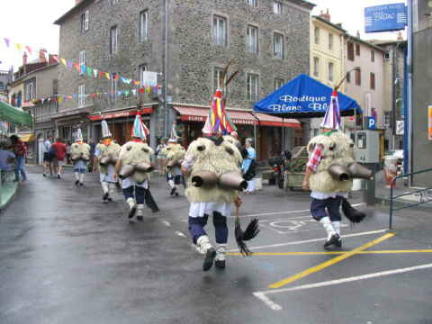
distracted from the instruments by a strange jangling sound. A group of
oddly-dressed men were assembling, wearing funny cone-shaped hats with ribbons
and a comical tuft of feathers attached at the top, and sheepskin vests with
four large cow-bells attached at their back. As I watched, they formed into a
line, two-by-two and took off down the street with an odd, bouncy but heavy walk
which made their bells clank loudly. As they paraded through town, they swished
the horse tail whisks in their hands and when they came to a plaza they would
circle it in single file once or twice before resuming their route or reverse
direction for a few yards before turning back to continue in the same direction.
The leader would occasionally blow a long blast on the cows' horn he carried. I
followed in fascination, feeling like I was watching an ancient ritual of
purification, of scaring away the evil spirits. I later asked the woman at the
information desk who they were and why they were doing what they were doing, and
she told me that they were Basque but beyond that she had no clue why they were
wearing bells. Oh well, I was safe in my fantasy…The route we took passed tables
of locally produced items; honeys and jam, spice cake, handmade baskets, tables
heaped with ruby red cherries, baked breads, pastries, cured sausages and
cheese. A few vineyards had tables also with samples of their wines from the
Saint Pourçain wine region. A group of violinists of various ages played simple
folk tunes while some women set out cups with a small amount of Salers liquor to
taste. As I mentioned earlier, it has quite a bitter, medicinal aftertaste so
after the first minute sip, we discretely looked for a place to throw away the
rest so as not to offend…
Our tires are starting to show signs of wear with all the
riding we are doing so we stopped at a large bike shop in the town of Issoire.
They had the tire and proceeded to do the work of taking the old tire off when
the mechanic called Mike over to look at something. The nuts holding the front
wheel on had been put on backwards by the last person who had mounted the tire!
The last shop to have done work on the bike was the large Yamaha shop in
Sevilla! It is mind-boggling to think that a professional shop would have put
the tapered nuts on with the wide end facing out… in any case, the new tire was
put on without a hitch and we
discussed whether or not the
back tire should also be replaced. It was getting close but not bad, so we
arranged to come back in one week, on a Monday. “You’ll have the tire we need on
Monday, right?” yes. “You’ll be here on Monday, right?” yes. “The shop will be
open on Monday, right?” yes, yes.
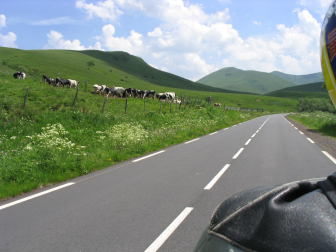 In a week’s time we’ve put on a lot more miles on the bike.
Fully loaded with our bags and both of us, the tires wear out quickly because
they are made of a softer material designed to grip the road. We still have some
miles left on the tire but the shop seems very competent so on Monday around
11AM we’re back at the door of the shop. The lights are out and no one is parked
in the parking lot. A sign on the door says, “Fermeture Exceptionelle today,
until 6PM…Oh well, we are due back in Paris in a few days and can wait to change
the tire there.
In a week’s time we’ve put on a lot more miles on the bike.
Fully loaded with our bags and both of us, the tires wear out quickly because
they are made of a softer material designed to grip the road. We still have some
miles left on the tire but the shop seems very competent so on Monday around
11AM we’re back at the door of the shop. The lights are out and no one is parked
in the parking lot. A sign on the door says, “Fermeture Exceptionelle today,
until 6PM…Oh well, we are due back in Paris in a few days and can wait to change
the tire there.
Previous Page
 Next Page