June 17th, 2003
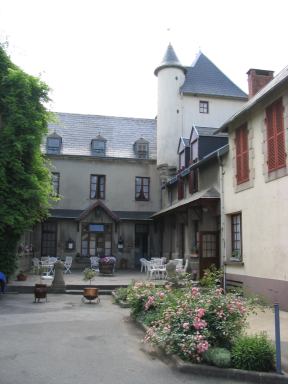
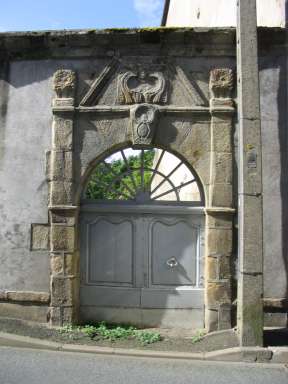
One evening we were looking for a place to stay when we entered a small, plain village called St-Gervais. Most of the few hotels in town looked run-down or closed and we were about to give up on the town when we spotted a sign for Castel Hotel 1904. Driving around the corner, we spotted a beautiful building with a small tower and vine covered walls which turned out to the hotel. Crossing a flowery patio, we entered a foyer where the reception desk sat, next to the fireplace displaying the date of 1616. We soon had a nice room - named Adelaide - for 60 Euros, overlooking a shady garden and furnished with furniture from the 20’s or so. Although it is not a big hotel, it has two restaurants. The “gastronomic” restaurant serves what we would consider “gourmet” food, but was closed the days that we were there. The regular restaurant had a fixed price menu and we had a really nice meal there for about 15 Euros. We were in love and decided to stay for a few days. It is not budget priced but we felt it is a very good value for the money. Not surprisingly, this hotel is listed in a book of French Hotels of Charm. We went into town and had coffee at a smart little café and from where we were sitting we could see lots of closed-up buildings abandoned for many years, and for sale signs. Occasional houses show signs of loving attention; fresh paint on the shutters, lace curtains and on the sidewalk, bright geraniums spilling over the sides of their pots. An odd little stone arch with a wooden gate opened onto a weedy garden. An interesting building with a rounded tower looked well-kept but the shutters were latched tightly closed and it was hard to tell if it was still being lived in. We stopped by a real estate office to take a look at the offerings and were told by a Dutch realtor that this area was the next “Eldorado”(!).
Back at the hotel, by chance, Mike ran into a pair of older
French gentlemen, locals, who spoke excellent English. They explained that they
had both worked in America before retiring – one for Massey-Ferguson and the
other for Alcoa – and are now living here in St-Gervais. Guy was married to a
woman from town – a cousin of the family
 running the hotel and
was actually born here right in that room, he explained, pointing up at the
hotel. After retiring, Paul decided to move back to St-Gervais with his wife and
live in the house that his Grandfather built. “People say it’s like a museum”,
he said. We sat and chatted for a long time until we noticed the time; if we
didn’t go eat dinner now we wouldn’t get anything. We agreed that they would
come pick us up after dinner and go to Paul’s house for a cup of tea. Over a
bowl of tea (the traditional French way!) in the flag-stoned kitchen, we learned
a lot about the town and the history of the area; how the tower house used to
have rabbits living at the base of the tower, the chateau which used to be
nearby and how all of the stones were taken away, many to build people’s homes,
how the strange little stone arches probably came from the chateau. Mike told
them he was interested in perhaps buying a house in France and they told us that
the St-Gervais was not a good place for us – too cold in the winter and hot in
the summer…better to try an area south east from here. We asked about the café
we had gone to earlier – we had wanted to get a coffee one afternoon but it was
unexpectedly closed. They told us it was run by a couple from Paris; they had no
experience in running a café but decided to retire to the country and open a
bar. If they don’t have customers or don’t feel like being open, they will often
lock up and go home or go fishing.
running the hotel and
was actually born here right in that room, he explained, pointing up at the
hotel. After retiring, Paul decided to move back to St-Gervais with his wife and
live in the house that his Grandfather built. “People say it’s like a museum”,
he said. We sat and chatted for a long time until we noticed the time; if we
didn’t go eat dinner now we wouldn’t get anything. We agreed that they would
come pick us up after dinner and go to Paul’s house for a cup of tea. Over a
bowl of tea (the traditional French way!) in the flag-stoned kitchen, we learned
a lot about the town and the history of the area; how the tower house used to
have rabbits living at the base of the tower, the chateau which used to be
nearby and how all of the stones were taken away, many to build people’s homes,
how the strange little stone arches probably came from the chateau. Mike told
them he was interested in perhaps buying a house in France and they told us that
the St-Gervais was not a good place for us – too cold in the winter and hot in
the summer…better to try an area south east from here. We asked about the café
we had gone to earlier – we had wanted to get a coffee one afternoon but it was
unexpectedly closed. They told us it was run by a couple from Paris; they had no
experience in running a café but decided to retire to the country and open a
bar. If they don’t have customers or don’t feel like being open, they will often
lock up and go home or go fishing.
Nearly every town or village we pass through has its own requisite monument to World War I with a plaque listing the names of the fallen villagers. Addendums were added after World War II and the war in Algeria. Mike has always wondered why the monuments never seemed to show any damage, so he asked Paul why the Germans never tried to destroy or deface the monuments during the war. "Good question", Paul answered. I guess it's a matter of speculation why but Paul thought it was because the Germans had respect for them. Paul told us that the worst damage they ever caused was to take the metal decoration or statues, if any, to melt down. The Germans actually only visited the area 2 or 3 times, Paul said, because there were so many places for French guerilla fighters to hide.
Before leaving, Paul showed us to his tiny living room, furnished by simple antique furniture and dominated by a large fireplace, and proudly showed us a new computer with which he promised he would keep in touch through e-mail.
With all the old volcanoes in the area it’s no surprise
that there are so many towns with natural hot springs and thermal spas. We
stopped one afternoon to have some coffee in a town called Chaudes-Aigues
(pronounced something like shod-zeg, meaning hot water in medieval French) where
a small fountain gushes water at 82C, the hottest springs in Europe. A cloud of
steam attested to the heat of the water - on
 the Celsius
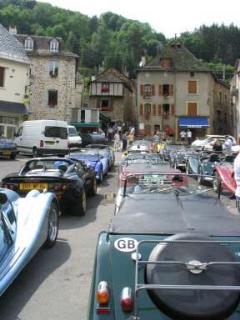
scale, water boils at 100 degrees. We amused ourselves by watching the town
square fill with British and French Morgans; it was a rally, and consisted of
twenty nine old Morgan cars and one Lotus 7. We also stopped in Mont-Dore one
day – briefly – where we had the afore-mentioned 3 Euro coffee. High prices and
tour busses full of tourists soon had us moving on. Chatel-Guyon is an elegant
spa-town, built at the turn of the century when “taking the waters” was
fashionable and was often visited by royalty and other famous figures.
Unfortunately we were on our way through and didn’t have time to explore the
town beyond gaping at some of the beautiful art-deco buildings as we cruised
past them. We will definitely have to come back some time.
the Celsius
scale, water boils at 100 degrees. We amused ourselves by watching the town
square fill with British and French Morgans; it was a rally, and consisted of
twenty nine old Morgan cars and one Lotus 7. We also stopped in Mont-Dore one
day – briefly – where we had the afore-mentioned 3 Euro coffee. High prices and
tour busses full of tourists soon had us moving on. Chatel-Guyon is an elegant
spa-town, built at the turn of the century when “taking the waters” was
fashionable and was often visited by royalty and other famous figures.
Unfortunately we were on our way through and didn’t have time to explore the
town beyond gaping at some of the beautiful art-deco buildings as we cruised
past them. We will definitely have to come back some time.
Vichy is without a doubt the most famous of all the spa towns. Napoleon III
regularly came here for the spas and was responsible for transforming the town
into a mini version of Paris, with a grand opera hall, lofty pavilions, casinos
and Haussmann style architecture. A promenade runs along the river and
Napoleon’s villa sits at one end of the park. A row of officer’s houses lines a
nearby street and features some very eclectic architecture. The town has
suffered a decline since Napoleon’s time, though. In the 1880’s there were some
280 hotels, but today there are only 60 and from what we could tell walking
around town, maybe half of these were closed. Once grand hotels sit empty or are
now residences for elderly people. Once chic stores now sell orthopedic shoes
and walkers. It is hot here, too and after a night of tossing and turning in a
smotheringly hot room, we decided to head back to Paris.
==============================================================================================================================
Castel Hotel 1904 can be found in the town of Saint-Gervais d'Auvergne. I don't have the address, but it's not a big town and there are signs pointing travelers to the few hotels in town. You can find their website at www.castel-hotel-1904.com .

 Next Page