July 2nd, 2003
Back in Paris, it’s still warm but tolerable. Our plans are
to stay in Paris for a few days then head east towards Alsace-Lorraine and
Germany. We have some friends to visit and some business to take care of. I am
looking forward to reorganizing my motorcycle bag; it has gotten too heavy and I
need to store some of the stuff I have collected along the way. We have to take
the paperback books we have already read over to the used bookstore where we
will trade them in for credit on some new books. And I am waaay behind on my
writing and need a couple of days to catch up!
Mike has a customer who had a problem with a heat-troller and lives near Paris,
so we took a swing by his place to take care of his problem and were invited to
stay for a few days. Stefan and his wife Jennifer had planned a barbecue for us
and another biker, Ted Simon who is on his way home after spending the last two
and a half years traveling around the world. Thirty years ago, Ted decided to
learn to ride a motorcycle so he could ride around the world from his native
England, down through Africa, up through south America, north America, Australia
and Asia before coming home again. He wrote two books about his journey and all
the adventures he had. A few years ago, he embarked on another epic journey to
re-trace his route which took him 2 ½ years this time. He shook his head sadly
as he remarked on how difficult the book of his latest journey will be to write,
as it will be difficult to put a positive spin on his view of the world as
compared to his first trip. He has returned with a saddened and pessimistic view
of the world, how things have changed and not changed; poor living conditions
going from bad to worse, government corruption, hunger and disease, the widening
gulf between rich and poor, the degrading environment, wars. The world was much
more naïve thirty years ago and the third world hasn’t learned from the mistakes
we have already made...
Stefan and Jennifer turn out to be my age and we have much in common. He is
originally from Sweden and is working in an office near Paris. Jennifer is
American and we hang out together at their rural home while he goes to work. In
the evening, Stefan and Mike putter around working on the bikes and commiserate
together on the frustrations of being a foreigner living in France. Stefan is planning a trip home
to Sweden in a few weeks with Jennifer on their BMW motorcycle and have invited
us to join them. We haven’t been to Sweden yet and this would be a good
opportunity but we will keep an eye on the weather map as the time gets closer
just to be sure. It tends to rain a lot!
One item of business is a trip to Citibank. My card had expired and I never
received a new one, so we had talked to them before we left for Spain and asked
for a new one. My new card was waiting for me at the bank but not the PIN code.
That has to be ordered and will arrive in one week because apparently it is
against French law to have the card and the PIN code at the same bank at the
same time. Unfortunately, in France,
you can’t pick out your own code and for security reasons it is impossible for
the bank personnel to look it up for you. Our three day stay in Paris becomes a
week and a half as we decide to wait for it to arrive.
We have discovered a great new hotel to stay in, called Suitehotel, but the
catch is that we can only stay there on Friday, Saturday and Sunday. For these
three nights, the total price is €139 – that's
€46 per night – including a
free breakfast of as many croissants and cups of coffee as you want. The room is large, 30 meters squared,
and tastefully decorated with wood paneled walls. The bath room has a glass-doored
shower and a separate bathtub. The toilet is in its own little room and there
are two small closets and shelf space so we can unpack our stuff and spread out
a little bit. A tiny microwave, fridge, electric water boiler, another tiny
sink, and a table make eating hot food in the room easier. A couch in the corner
will make up into an extra bed but during the day has three large soft pillows
on it, just perfect for lounging and reading while sipping a cup of tea made
from the selection of instant coffee and tea in your room. Woven room dividers
pull out from the wall to separate the bed from the desk/table area a person can
work while the other sleeps, and the phone is conveniently located by the desk.
(there have been quite a few nights when Mike gets up at 2AM to write e-mails or
do some research on the computer). And, although the Suitehotel is not in the
center of Paris, it is close to the metro and very convenient. Ok, so the
problem is that for the other four days of the week the room costs €89 per
night, so on Monday we move back to the Etap Hotel where we always used to stay.
The Etap hotel, in contrast, is €46 a night in Paris and can be found in
the outskirts of most of the larger towns in France. The room is smaller, with
no free breakfast, no closets or shelves, no phone, no microwave, fridge, or
water boiler or any of the other extras. It is plain-vanilla in its décor and
its main attraction is that it is clean and cheap and has its own shower and
toilet, and you always know what you are getting when you book a room in an Etap
Hotel because all the rooms are pretty much the same.
We found a nice new café in Paris called Sesame, alongside the canal St. Martin
in a quiet neighborhood. Run by a trio of a French man and two American women,
the café serves simple food like toasted bread topped with a variety of
ingredients, sandwiches, beautiful salads and perhaps the only authentic
American style fresh fruit smoothies in all of Paris. But their real passion is
coffee. Their espresso is rich and perfumy, and the foam topped lattes are
served in a generously large white mug. We asked for a cappuccino the first time
we went there. Outside of Italy, we have found that there is a lot of confusion
as to the proper way to make a cappuccino. The French usually give you a shot of
espresso with milk, and topped with sweet whipped cream and chocolate powder.
So, at Sesame, when we both ordered a cappuccino, she responded by asking
whether we wanted it wet or dry. Most people, she explained, didn’t know that a
“real” cappuccino is “dry” - just a shot of espresso topped with several inches
of milk foam. The “wet” version has milk. She made us one to try, so we could be
sure to get exactly what we wanted. Definitely not your typical French service.
I have to explain here that typical French coffee tends to be quite bitter, at
least to my taste, so when we find someplace like this that has really good
coffee, it is really exciting. Finding a coffee to go is not easy; the French
tend to be very traditional and always drink their coffee sitting at the
restaurant. Coffee lattes are also not very common, although I am beginning to
see them occasionally – although there is one French chain of American style
espresso coffee shops called Columbus Café, that sells espresso drinks and
fresh-baked muffins (to die for!).
After a few warm days, the weather changed and it started to rain. Leaving the
bike at the hotel one day, we took the metro into town and went to eat lunch at
Sesame. Looking out at the canal through the large plate glass windows, I
watched the showers come and go, dimpling the water of the canal. A single
person sat at the edge of the canal, an old woman fishing in the murky green
water. When it would begin to rain, she’d pull the umbrella out from under her
chair and huddle under it for a few minutes until it stopped, then fold up the
umbrella and replace it under her chair. A perfect day for sitting around, so I
pulled out the laptop and did some work while Mike read and sipped a perfect
latte. Lunch had been a Tartin; a piece of peasant bread this time topped with
mozzarella and cherry tomatoes, served with a small green salad and cold new
potatoes on the side.
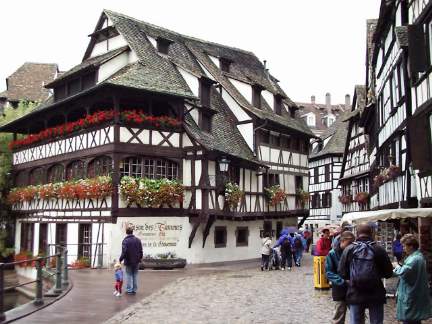 The
heat wave has broken and we are back the typical showery weather pattern. From
Paris, we headed east and spent a couple nights in Strasbourg, about 300 miles
away and near the German border. It is a very picturesque area
and has a very German feel; the names of the towns and the streets are
German, the food is German but you are still in France. The older locals speak a
patois mix of German and French which can still be heard. We are not planning to
spend much time this trip exploring the charms of the Alsatian villages, with
their villages of half-timbered houses alternating with fields of corn and
grain. We have an appointment at a manufacturers of leather motorcycle clothing
called Spool, where Mike was able to get a set of leathers for an amazingly cheap price.
The
heat wave has broken and we are back the typical showery weather pattern. From
Paris, we headed east and spent a couple nights in Strasbourg, about 300 miles
away and near the German border. It is a very picturesque area
and has a very German feel; the names of the towns and the streets are
German, the food is German but you are still in France. The older locals speak a
patois mix of German and French which can still be heard. We are not planning to
spend much time this trip exploring the charms of the Alsatian villages, with
their villages of half-timbered houses alternating with fields of corn and
grain. We have an appointment at a manufacturers of leather motorcycle clothing
called Spool, where Mike was able to get a set of leathers for an amazingly cheap price.
Heading out of Strasbourg, we went north,
with the goal of reaching a town just over the German border called Pirmasens
where we wanted to visit a manufacturer of bike intercoms (Baehr). The sky was grey with
incipient rain but the ground was still dry so we headed off towards the small
roads through thickly forested valleys, moisture hanging in the air as fog just
above the ground. We stopped for lunch at a small restaurant in a small town,
still on the French side of the border and had a quick meal. It was a bit
disconcerting to speak to the waitress because she seemed to be speaking a
strangely accented German and although I spoke German to her we had a hard time
understanding each other. My lunch consisted of potatoes with onions, fried to a
dark brown with a small pot of cream cheese with chives and garlic on the side.
A small green salad and a couple of slices of ham and cured ham rounded out the
plate. It was simple but absolutely delicious, a comfort-food meal for a grey
day like today.
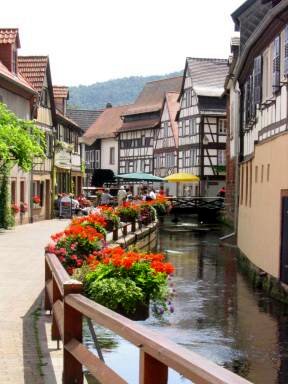 After getting a new intercom installed (oh
yay! It’s so nice to have something that works right! It really is nice to be
able to talk to each other as we ride), we rode through a sudden downpour to a
town called Annweiler to find a hotel for the night. It turned out to be a cute
little town of old Fachwerk houses with a canalized river running through town
powering mill wheels that a few hundred years ago provided power to the bark
mill and tanners. Now the wheels have been converted and now turn the water’s
energy to electricity for the town. Other, more recent homes from the 1800’s
were built from an unusually colored dark rose pink sandstone found in this
area. A castle called Trifels sits on a high peak overlooking town; an unusually
plain square building with a steeply pitched roof of terra cotta tiles.
After getting a new intercom installed (oh
yay! It’s so nice to have something that works right! It really is nice to be
able to talk to each other as we ride), we rode through a sudden downpour to a
town called Annweiler to find a hotel for the night. It turned out to be a cute
little town of old Fachwerk houses with a canalized river running through town
powering mill wheels that a few hundred years ago provided power to the bark
mill and tanners. Now the wheels have been converted and now turn the water’s
energy to electricity for the town. Other, more recent homes from the 1800’s
were built from an unusually colored dark rose pink sandstone found in this
area. A castle called Trifels sits on a high peak overlooking town; an unusually
plain square building with a steeply pitched roof of terra cotta tiles.
Fachwerk is the
German term for the quaint old houses built in the style we would call
half-timbered. It was a common (and probably the cheapest and easiest)
construction method of the 16- and 1700’s. A wooden frame was put together, and
stood up to form the outer walls, much like the 2X4 frames which form the inner
walls of modern houses. The difference here is that the timbers remain exposed
and the spaces between were filled with some material such as a mixture of mud
and straw, or brick. The filler material was then plastered over and the wood
timber painted with some preservative. I saw a few fachwerk houses in the
process of being restored; stripped to a skeleton of wood, the mud and straw
filling is often being replaced with something more supportive like bricks. Over
time, the half-timbered houses tended to sag, houses leaning companionably on
each other and the horizontal beams gently warped or slanted with age.
======================================================================================================
Suitehotel and Etap can be found on the web - as well as
all the other brother and sister hotels - by going to
www.accor.com
Previous Page
 Next Page