July 6th through July 22, 2003
From Annweiler, we wound our way north through the Mosel wine-growing area and into Luxembourg. Once we had crossed into Luxembourg, we stopped at a gas station to get some gas and were amazed at the price of a liter of gas here – only € .75 as compared to €1.08 in France. We followed a scenic road that looped alongside the river Our which marks the border between Luxembourg and Germany and had a quick lunch at one of the many picnic tables set off one side of the road. The speed limit in Luxembourg is relatively slow and most of the locals drive slower than the limit, so our trip through the small country was relatively leisurely. Entering each of the small towns along the road, an electronic sign displays the speed of each vehicle passing through its radar to remind motorists to slow down. Despite all of this, we were soon in Holland (after squeezing a few more liters of gas into our tank!).
We weren’t in Holland long, however, because we were on our way to meet Stefan and Jennifer in Aachen, Germany. They were in town for a couple days to have some work done on their car and do some shopping for things they can’t get in France. Aachen is a pleasant town, with a core of pedestrian shopping streets with modern buildings and a few old buildings. We had dinner in a restaurant that had to be one of the oldest buildings in town, a small place built onto the side of the Rathaus (rathaus is German for city hall). Looking out at the square from the upstairs dining room through small panes of convex amber glass, I spotted a Starbucks – the first one I had seen outside of Vienna and London. As I was to find, Germany had embraced the espresso trend whole heartedly and every where you go you see signs saying “coffee to go”.
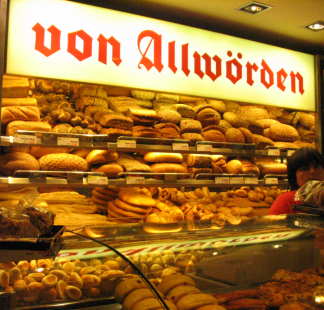
In the pedestrian shopping area, some of the most show-stopper displays are not designer clothing or jewelry, but baked goods. The photo to the left barely does it justice. The bakeries here, and indeed all through Germany, feature beautiful displays of the most mouth watering breads. But to call it simply bread would be to put it in the same league as factory baked white bread (which is available here but is only eaten toasted!). Rye, wheat, wholegrain, pumpernickel, seven grain, sesame, poppy seed, caraway, anise, sourdough, white, gray or black. Rolls, braids, twists, long loafs, round loafs, rolls with seeds and nuts crusted on the top, both soft and hard, fitness, bio, the variety is endless - almost. I won't even go into the sweet varieties of breads! Mike is very partial to the pretzel bread; shiny, dark brown and crusty on the outside and sprinkled with coarse salt, soft and white on the inside with the same distinctive pretzel taste. It can be found twisted in the traditional pretzel shape, bigger than your palm, or in a fat breadstick shape, half a foot long and 1 1/2" wide - big enough to make a sandwich out of. Bakers here pride themselves on producing several hundred varieties of bread from the sweet raisin brioche to a strong flavored dense rye bread. Customers piling up in line behind you get increasingly fidgety as even the Germans need help because the names of the types of bread can vary from region to region. Bread in Germany is so important that they still call their evening meal “Abendbrot” (evening bread) which usually features a variety of breads with cheese and cold cuts. Aside from breads, rolls and sweets, at the bakery you can also purchase small sandwiches of a seedy roll with a few slices of cold cuts and/or cheese, lettuce, tomato and cucumber slices.
Our next stop was in Nordhorn, Germany, about 150 miles north of Aachen on the Dutch border. We had an appointment to get a new suspension for the motorcycle from a company called Wilbers, installed at the factory. We had taken the autobahn almost the whole way and because the road is lined with trees and bushes, it was rare to catch a glimpse of the countryside we were traveling through. Eventually, though, the Autobahn petered out just south of Nordhorn and we suddenly found ourselves in a landscape so flat it looked like the creator had dragged the edge of a ruler across the land to make the ground perfectly flat and level. We saw lots of windfarms; tall windmills dotting the landscape with immense propeller blades mounted on tall stalks, slowly turning to create electrical energy. We passed lots of farms, planted with corn and grains, fields bordered by trees, plain, unadorned brick farmhouses with steeply pitched roofs and pastures with black and white cows. Once we got to Nordhorn, we had the challenge of trying to find the place since we had no instructions on getting there and no address. It was very difficult to find but after asking several people how to get there, we finally found the place. Pulling up to the door, we were surprised to see another GTS!
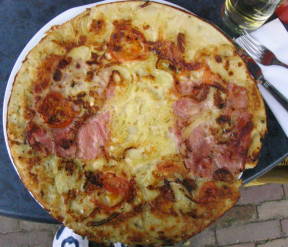
We didn’t see much of Nordhorn aside from the road between our hotel and the industrial area that Wilbers was in, but it seemed to be a quiet community with lots of trees and plain small brick houses. The sound of bicycle bells was in the air from bicyclists on the wide bike paths that run alongside the sidewalks. We went down the road a few miles, into Holland for lunch to a popular restaurant famous for their pancakes. Dutch pancakes are not like the ones you would get at IHOP; they are large and a little thicker than a French crepe. They come with just about any topping combination you could think of, both sweet and salty. My pancake, when it came, was topped with ham and cheese, onions and tomatoes. The photo shows my pancake, nicely browned, big as a pizza and totally covering the plate underneath. Mike got one topped with meat and cheese with a mildly spicy Indonesian peanut sauce. After stuffing ourselves, we headed back to Wilbers so they could finish the installation and we could hit the road again, hoping to make it to Hanover before dark.
I like traveling in Germany, and I feel comfortable here because I speak enough German to get by. The biggest problem with traveling in Germany as we do, is finding a way to connect our laptop in order to send and receive mail. Most of Germany uses digital ISDN phone lines, which require a special modem different from the one built into our computer. ISDN modems are surprisingly big and bulky, and one more thing to have to carry. It is possible to find analog phone lines but because there is so much noise on the line it is impossible to get a fast connection and sometimes prevents us from connecting at all...
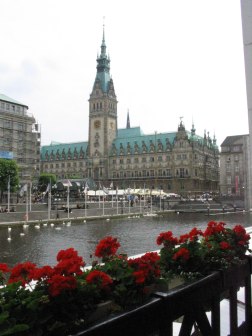
We had made a weekend reservation at the Suitehotel in Hamburg which lies further North and East at the base of the peninsula which becomes Denmark. It has been an important trade and shipping center for hundreds of years and carries its heritage gracefully in its elegant brick merchant warehouse district, its busy harbor on the Elbe river – the largest seaport in Germany - and the distinctive skyline of its telecommunication tower and its churches.
The Rathaus is a magnificent sandstone “palace” built in a neo-renaissance style (photo at left), with a green copper roof. In addition to all the green parks in the city, a large lake sits right in the center of Hamburg and numerous canals criss-cross the city, left from the days when 19th century shipping merchants would use the canals to transport goods by boat to their warehouses.
There are also several fashionable shopping streets where one can find designer goods and jewelry, big shops filled with electronics, sidewalk cafes and a Burger King in a mock-Greek temple. On the weekends, these streets are especially lively, with crowds of people strolling up and down and two or three brass ensembles playing classical or big-band music on the sidewalk. In one of the electronics shops, we saw a new laptop, tinier even than the one we carry and only 2 or 3 pounds. It doesn't seem to be available in the U.S. where electronics cost a lot less, though, and to buy it here would mean using a German keyboard which is different from the U.S. It is sometimes difficult to keep up with my writing and Mike at the same time keep up with his correspondence using the same computer. It would be nice to have a second computer if we could find the space!
Our hotel was not far from the lake so we walked to one of the marinas a took a ferry boat to the “downtown” area of Hamburg. We walked around a bit and found a wine festival going on in the square in front of the Rathaus, featuring the wines and foods of the area around Stuttgart. We tried the wine, a light fruity red wine served in a real glass with the logo of the wine festival. In the interest of being eco-friendly, the Germans have adopted system of using real glass glasses and washable plastic plates at public functions like this, so we had to pay €.50 for each glass, which we could take home or have refilled with another wine. In fact, we were told, you can even bring your own glass and avoid paying a deposit at all. We had gone back a second time the next day and had not brought our old glasses with us, and got stuck with another set of glasses because they do not have the facilities to wash them there. The plastic plates and silverware carried a deposit fee of 1 euro each, refundable when you return them to the counter. To go with the wine, we tried the Maultaschen, a sort of German ravioli. We discovered the secret to making maultaschen as we watched a young man roll out a large sheet of pasta dough on a table, spread it with a paste containing a mixture of pork, cheese, and I don’t know what all else, then roll it up like a strudel and cut it into pieces about 3-4 inches wide. After boiling then, the finished maultaschens can then be served with a cream sauce with mushrooms or, as we had it, cut into smaller pieces and scrambled with egg. Rather like using left-overs from dinner the night before, I image…
Germany has for many years been a country conscientious about recycling. In the grocery store, plastic bags are not handed out for free; you can either pay for one or bring bring your own bag or basket to carry your purchases home. Most beverage bottles, whether plastic or glass, carry a deposit of €.50 or €1. Bring the empty bottle and receipt back to the store where you bought and you receive the deposit back. And most public garbage receptacles have four bins; paper, glass, plastic and metal, and garbage.
The u-bahn stop is also conveniently located near the hotel; the u-bahn is a very nice, modern and very quiet subway system, with roomy seats and LCD display monitors which tell you which stop is coming up next, and which important tourist attractions can be reached from that stop. In between, you get cartoons and brief announcements of up-coming events. On Sunday, we took the u-bahn to a northern neighborhood to a park-like cemetery quite unlike any I have seen elsewhere. The grounds are filled with trees and shrubs, with grave markers tucked discretely here and there with occasional sculptures of grieving angels and other things typical of a cemetery. Walking down quiet paths one can occasionally see family members tending the graves, planting flowers or trimming the tiny hedges that surround some of the sites. Bins are placed around the park for compost materials and garbage like spent candles, and gardening tools such as watering cans are available for people to borrow.
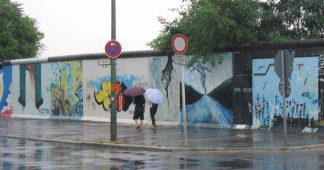
After Hamburg, we headed towards the Eastern border of Germany to spend a few days in Berlin. Driving in towards our hotel we went through a weedy suburb with occasional abandoned factories bearing fresh spray paint in the form of graffiti. We passed the 1 kilometer long section of the old Berlin wall that still exists, covered in painted murals, some peeling with age. We stayed in an Ibis hotel near the east train station, another French chain of hotels which was running a special summer price of 40 Euros a night. I asked the guy at the desk for a map of town and he pulled one out along with a fat blue marker. Here, he explained while making a fat blue line on the map, is where you can find the section of the old wall that is still standing. Continuing on, he made a dashed line which encompassed a large section of the eastern side of town representing where the wall had been. And when I asked where we could get good coffee, he made a fat blue dot where I could find a Starbucks. Then another and another – there are 8 Starbucks in all here in Berlin, operated by a large German department store chain called Karstad.
Carrying my spotted and dashed map, we headed to the train station to take the u-bahn into town. Three stops later we got off at Hakescher Markt, a funky area that has become a popular area for hanging out. The plaza below the attractive old brick train station has a series of bars where twenty-somethings gather to drink fancy cocktails and socialize. A troupe of French fire throwers entertained the crowd dancing and twirling flaming torches while another exhaled flames like fiery dragon’s breath. Restaurants in the area feature foods from many cultures, like sushi, Jewish food, or the Thai food we had for dinner one night.
Not far away, we walked past an old Jewish temple, called the new synagogue. It is a beautiful old building somewhat Moorish – Sephardic in design, with elaborate arches and windows. Its ornate gold and turquiose domes were barely visible through the leafy tree branches making a good photograph impossible. Wide concrete barriers blocked the lane of traffic closest to the temple and the sidewalk traffic was diverted to the street inside the barrier while armed security guards patrolled alertly in front of the building. It was the synagogue where the “kristall nacht” started, when the Nazis set the building on fire and ordered a huge anti-Jewish demonstration that turned into a riot. The building was an empty shell for many years but is now restored to its former beauty and a plaque on the wall reminds us to "never forget". Nearby a Jewish museum and other Jewish businesses were also fortified in the same manner. Unfortunately in these “modern” times, it seems to still be a target for terror.
Some of the buildings in the neighborhood have had meticulous restoration although some stand out like a black tooth. One such building, sandwiched between shining white-painted buildings, was missing much of its plaster showing the deteriorating brick underneath. A battered wooden door stood open showing signs of occupancy amid the rubble of the courtyard and vines climbed the outer façade like leafy green cobwebs. Other buildings, only a few decades old clash with their surroundings as if the architecture of the neighborhood was not taken into account. No doubt built quickly of cheap materials, the angular structures have not aged well and what may have once looked modern and progressive on paper now just looks plain ugly, streaked and shabby.
We walked down the road called “Unter Den Linden” (under the Linden trees), a broad elegant avenue with a park down the middle. At the end of the avenue, we passed through the Brandenburg Gate, which once marked the boundary from East to West, and were soon in a huge forested park that lies in the center of Berlin laced with paths for walking and bicycling. A huge zoo, one of the largest in Europe sits at one end of the park and was the first Zoo in Germany, dating from the mid 1800’s. At the far end of the park is the beginning of Kurfurstendamm, a busy street lined with fancy shops and restaurants and hordes of shoppers. After looking around and admiring the grand old architecture, we hopped back on the subway and headed back home. All in all, we found Berlin an interesting city, with lots to do but a relaxed atmosphere, funky and elegant in equal measure.
Soon enough, it was time to leave Berlin. Back through the suburb we had passed on the way into Berlin, the road was lined with elegant apartment buildings that looked like they had probably been built 100 years ago. Flowery balconies and wide front doors, many of the facades of the buildings were adorned with statues and the faces of women carved in stone. Driving by and looking up at them through the branches gave me the curious feeling of a host of people peering at us through the leaves.
Mike wanted to go back to Wilbers to have them change the spring on the suspension because he felt it wasn’t quite right, so in one epic day, we crossed back to the other side of Germany again, then after the work was done, we rode back up to Hamburg to meet Stefan and Jennifer to embark on our trip to Sweden.
 Next Page