 and admitted having been born here but added, “I am from Mesopotamia. Have you
heard of it?”.
and admitted having been born here but added, “I am from Mesopotamia. Have you
heard of it?”. July 18th, 2003
We have been in Sweden now for about two weeks, bouncing from one location to another in no logical order. We meet up with Stefan and Jennifer when they are available, in between their visits with friends and family and Stefan’s business meeting in Gothenburg. It is a country outside of the European community, which means that for the first time this year, we have had to get used to a different currency and exchange rate of about 8 kronas to one dollar. (Although they are due to vote on switching to the Euro soon and some people speculate that although they don’t really want to, it will probably happen. Having watched prices go up in Europe as a result of the Euro coming in, they are afraid that prices will go up in Sweden too).
Sweden is a huge country by European standards, and Swedes
like to tell us that if you took the country, from top to bottom and flipped it
over, it would reach from the tip of Sweden all the way to Rome. All this space,
and there are only 9 million Swedes to populate it. Many of them are the
stereo-typical blonde and tanned, fluent in English. Many of the children have
hair so light it appears white. There is a large population though, at least 1
million of them people who are not blonde, they are mostly immigrants from Arab
or Asian lands. We like asking them where they are from. Although they have been
born and raised in Sweden, they never reply that they are Swedish as if it is
obvious that they couldn’t possibly be natives. One girl we talked to said she was from a
small country, “I don’t know if you have heard of it. My country is Persia. But
it’s not called that any more”. We looked at her incredulously. She hedged a bit
and admitted having been born here but added, “I am from Mesopotamia. Have you
heard of it?”.
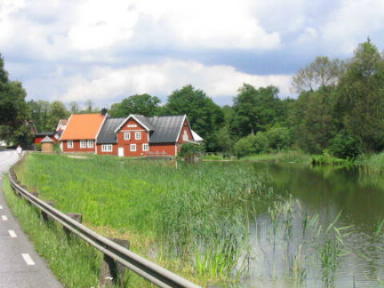
The country is pretty in a rural kind of way and when it isn’t planted with a crop or used as pasture, is laced with small lakes and forests containing a variety of wild-life including moose. The south part of the country is the most populated and the land is mostly flat but not spectacular. The typical Swedish house is a two story wooden building, very plain, and painted a dark red with white and/or black trim. Some of the less conventional home owners have painted their houses in other colors – white, yellow, green or blue. Nearly every home has a Swedish flag in their immaculate yard; a golden yellow cross on a sky blue background. It reminds me a lot of the Pacific Northwest (except for the flags!) especially near the coast, where the stands of partially clear-cut pines reflect in small lakes.
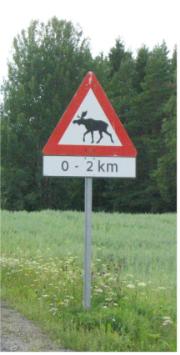
The main thing that we find restraining here is the speed limits on the network of 2 and 4 lane highways. The speed limit is 45 to 55 mph and we were sternly warned by Stefan to watch our speeds because if you get caught speeding, you can receive a stiff fine, and if you are going 20 – 25 mph over the limit, your vehicle could be confiscated. If you are a foreigner, they will escort you directly to the border…To make matters worse (for those who like to go fast at any rate!) is that most Swedish drivers normally drive about 15-20 mph slower than the speed limit! Luckily, most of the 2 lane roads have a broad shoulder where the slower drivers will drive so others can pass. Since we rarely saw any police, I guess they are looking out for a moose; we were also warned to keep our eyes open for these large creatures. If you see one, there is probably more around especially in the evening when they come down to the water to drink.
People are always telling us how safe Sweden is; they are very trusting and depend on the honesty of others. Unafraid of having anything stolen, bikers here will often leave helmets and leather gear draped over the bike while they shop or get some lunch. In the country, you will often see unattended vegetable or flower stands where you can take what you want and leave some Kronar in a glass jar for payment. On the other hand, to discourage hold-ups in some convenience and grocery stores, money paid for goods goes straight into a sort of vending machine contraption; you put your coins in a slot and the cashier slides the bills into another machine. Change is automatically dispensed by the machine.
So. When we left Germany to go to Sweden, we headed effortlessly out of Hamburg following Stefan and his GPS to the road to Denmark. (we tend to get lost a lot, especially in big cities, and it is becoming apparent that we need to get one too!). In about 70 miles we caught the ferry in Puttgarden, which took about 1 hour to cross to Denmark, just about enough time to catch some lunch before heading back to the bikes.
The drive through Denmark was pretty uneventful. With a speed limit of about 55 MPH, we had plenty of time to see a mostly flat landscape of grain fields dotted with farmhouses and windmill power generators. One thing that did worry us though, was a grey sky and damp pavement as if it had recently rained. After a few hours we had passed Copenhagen and were at the foot of a long toll bridge that would take us over the Ostsee to Sweden. Ominously, a huge cloud hung over the bridge starting at mid-span and obscuring our first view of a country we’d never been to before.
We were lucky though, and were only sprinkled on a little bit as we made our way under black skies to the small town called Höör in southern Sweden where Stefan’s brother lives. The damp air smelled honey-sweet from fields of blooming clover. We passed through a flat countryside with farms and village after village of small red houses, ponies and horses grazing in pastures. There were many groves of trees too, and occasionally we’d spot a yellow triangle caution signs with a black moose on it.
We stayed with Stefan’s brother, Conny, and his wife Monica for a couple of days. Sitting in the back yard chatting one night, the guys were drinking beer but I didn’t feel like having any beer, so Conny handed me a can of something and said, “Here, I think you’ll like this”. It turned out to be cider made from pears, light and sparkling, a little sweet and very refreshing with a distinctive pear flavor. I was hooked. It seems to be a national drink, available everywhere. You can find cider in many flavors, including blueberry, raspberry, apple, and even weird combinations like mandarin-chili and cactus-lime, but pear is by far the most popular.
One night, we walked to the “busy” center of Höör to eat pizza. Walking through the neighborhood of tidy houses with large but beautifully kept yards with lots of trees and flowers, it seemed like a ghost town because there were few cars on the road and few people to be seen. The pizza place had tables on the sidewalk in front and we were treated to a “parade” of cars cruising up and down the street. A pair of teenagers in a vintage Volvo pickup truck, another young pair in an old ford convertible from the 50’s. And a middle aged couple in a vintage Cadillac convertible complete with tail fins passed three or four times. It seems the Swedish are crazy about classic American cars and restore them with loving attention. Every seems to know each other and as the cars pass slowly by, people greet each other and wave.
 The
morning after we arrived, of course, the sun was out and the sky was a brilliant
blue. We took a nice ride through the country, on a beautiful Saturday afternoon
in the warm sun. Now that the weather had improved we could see that the fields
of grain were edged in wild flowers, and more pastures with beautiful horses and
small native ponies. We rode north a bit, up to a rocky shore, and had lunch in
a restaurant with a view of the sea then walked down to the water where families
had spread out their blankets on the rocks to sun themselves and have picnics.
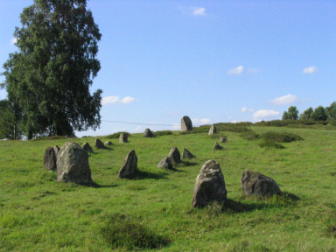
On the way back to the house, we stopped at an ancient grave-field of standing
stones marking graves from 550-900 A.D. Some of the stones were standing alone
in the midst of a heather filled sheep pasture, but a few of the graves were
marked by an arrangement of stones in an oval shape to represent a boat.
Archaeologists investigating the site determined that the graves contained the
remains of funeral pyres.
The
morning after we arrived, of course, the sun was out and the sky was a brilliant
blue. We took a nice ride through the country, on a beautiful Saturday afternoon
in the warm sun. Now that the weather had improved we could see that the fields
of grain were edged in wild flowers, and more pastures with beautiful horses and
small native ponies. We rode north a bit, up to a rocky shore, and had lunch in
a restaurant with a view of the sea then walked down to the water where families
had spread out their blankets on the rocks to sun themselves and have picnics.
On the way back to the house, we stopped at an ancient grave-field of standing
stones marking graves from 550-900 A.D. Some of the stones were standing alone
in the midst of a heather filled sheep pasture, but a few of the graves were
marked by an arrangement of stones in an oval shape to represent a boat.
Archaeologists investigating the site determined that the graves contained the
remains of funeral pyres.
Conny and Monica’s daughter, Nana, is a cheerful 21 year-old. A classic Swedish blonde with a wide smile, she had spent a year as an exchange student in New Zealand and her fluent English has a distinct Kiwi accent. I was treated to 4 volumes of photos of her time there, with some very nice photos of the country and some silly photos of her friends. She was sad to see us leave and fervently told us to come back any time we wanted…
From Höör, we rode up the west coast to Gothenburg, while Stefan and Jennifer went to visit his dad. We stayed in an Ibis hotel, which turned out to be floating in the river, not far from the harbor. Built in Hamburg and towed to Gothenburg years ago, it looks like a boat and has a nice deck for sitting and watching the boats go by, and although the hotel floats, you don’t feel any movement. The rooms are also tiny, as befits living on a boat! We flipped on the TV and found that most of the programming was in English, sub-titled in Swedish. From old series – Miami Vice, Dallas, Charlie’s Angels – to the latest sit-coms and dramas. This helps to account for the ability of the Swedish to speak English – I would say that 90% of the people here speak English fluently. I was told that they have to be able to speak at least 2 foreign languages in order to graduate from school.
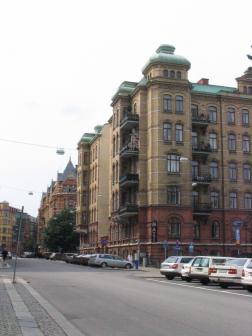
Here are some of the facts I learned about Gothenburg; it was founded in 1621 and built according to Dutch designs with canals and fortifications. Gothenburg became one of the most heavily fortified cities of the period with a with water moat, a city wall and three fortresses. On the north sea, it was a center of trading silk, tea, furniture, porcelain and precious stones with China and the Far East. A portion of the double moat remains, ringing what was then the inner city, lined on either side with a park shaded by trees. The main drag, called the Avenue, is lined with cafes and restaurants and is the hip place to go on a Saturday night. Most of Gothenburg’s tourists can be found here or in the huge mall nearby; Americans, Germans, Spanish and a few Dutch. Power lines criss-cross the streets for the old fashioned trolleys that run along them. We walked around a bit to see the sights but there isn’t much to see in Gothenburg, it’s mostly a quiet, pleasant city and a good place to go shopping. Off the main drag, the streets and sidewalks are usually empty.
Walking back to the boat one night, we walked through a residential area that seemed deserted. Although it was twilight, few lights were on, no cars were on the street and it seemed like no one was home. Turning a corner, we started hearing voices as if a raucous party were going on and it seemed strange that Swedes would be so loud. As we passed under the balcony, however, we realized that the boisterous voices were speaking Spanish, at normal Spanish volume!

 Next Page