July 23th, 2003
From Gothenburg, we had a few days to
kill so we went to Stockholm for a few days, which means we had to go from the
west coast to the east coast in one day. Luckily, Sweden is much narrower than
it is long, but even so, it took us 6 hours. We were told that we had made good
time, because the speed limits are so slow.
Once we got to Stockholm we went to see a friend of
Stefan’s whose sister has a small business hotel where we would stay. Stefan’s
friend, Olle has a motorcycle workshop where he repairs and sells Goldwing
motorcycles and Mike was able to borrow some tools and equipment to test the
battery on our bike. Our new intercom was giving us a little trouble; we were
getting static for no good reason, but the battery seemed to be ok. Olle’s wife
showed up in a bright red Mustang convertible to take us to the hotel and after
dinner, they took us on a twilight tour of Stockholm.
 The next morning we met the sister running the hotel. She
wanted us to pay for the room this morning, since she was leaving on vacation in
a few hours - heading for France to play golf - and there would be no one in the
office for a couple of weeks while she was gone! A Chilean refugee family was
living in the dormer room; we saw the man of the family working around the hotel
grounds and we later encountered the boy in the parking lot, a curious kid of
about 10 years old who spoke to us in a bizarre mixture of Spanish and Swedish,
asking about us and the motorcycle. Olle’s sister explained to us a bit
resentfully that they had been staying there for about 2 months, paid for by
Swedish taxes – meaning that the Swedish government is quite generous to people
who come to live in Sweden. Aside from the Chileans, only a few guests were
staying there though we never saw them, and a maid cleaned rooms on the
weekdays. A kitchen with refrigerator and microwave were available for use, as
well as a coffee machine where we could get coffee for free. In the basement was
a laundry room with some washing machines, an extractor to spin the excess water
out of our clothing, and dryers which we could also use for free. Cool! It’s
about time for doing a load of laundry.
The next morning we met the sister running the hotel. She
wanted us to pay for the room this morning, since she was leaving on vacation in
a few hours - heading for France to play golf - and there would be no one in the
office for a couple of weeks while she was gone! A Chilean refugee family was
living in the dormer room; we saw the man of the family working around the hotel
grounds and we later encountered the boy in the parking lot, a curious kid of
about 10 years old who spoke to us in a bizarre mixture of Spanish and Swedish,
asking about us and the motorcycle. Olle’s sister explained to us a bit
resentfully that they had been staying there for about 2 months, paid for by
Swedish taxes – meaning that the Swedish government is quite generous to people
who come to live in Sweden. Aside from the Chileans, only a few guests were
staying there though we never saw them, and a maid cleaned rooms on the
weekdays. A kitchen with refrigerator and microwave were available for use, as
well as a coffee machine where we could get coffee for free. In the basement was
a laundry room with some washing machines, an extractor to spin the excess water
out of our clothing, and dryers which we could also use for free. Cool! It’s
about time for doing a load of laundry.
There was a phone in the room and Mike was told that he
could get a line out of the hotel but when he tried it, he couldn’t get it to
work. After talking to Olle’s sister, and going back and forth between the room
and the office, trying different things, it finally came out that they had had a
new phone system installed in the hotel but after they had paid for it, they
realized that the calls from the rooms could not be metered so they simply shut
off the phones to outside calls. They wouldn’t know how much to charge us for
our phone calls so they wanted us to pay a deposit of 1000 Krona - around
€100! We finally got it worked out; after I showed them a
bill from 3 days in the previous hotel which came to about €10,
we agreed on a deposit of €20 which
she promised to charge back to our visa once the phone bill came and she figured
how much we owed…
 After taking care of business, we were ready to do some
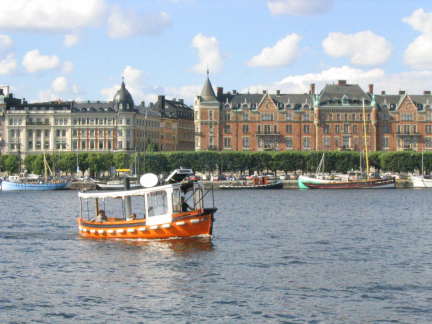
sight-seeing. Stockholm is a beautiful city built on a series of islands linked
by bridges and ferries, located between the Baltic Sea and Lake Malaren. We were
able to easily go into town from the hotel on the local train and started
exploring after a quick stop at the downtown tourist information center to get
maps and to ask some questions. Three days is hardly enough to spend here, but
we managed to see quite a bit.
After taking care of business, we were ready to do some
sight-seeing. Stockholm is a beautiful city built on a series of islands linked
by bridges and ferries, located between the Baltic Sea and Lake Malaren. We were
able to easily go into town from the hotel on the local train and started
exploring after a quick stop at the downtown tourist information center to get
maps and to ask some questions. Three days is hardly enough to spend here, but
we managed to see quite a bit.
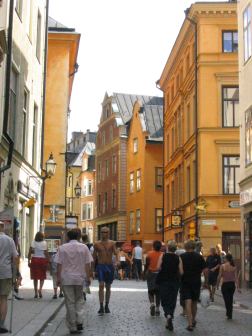
Gamla Stan is a small island of close alleys and old
buildings painted a mustard gold color with lots of medieval charm. It’s where
the city got its start and is now densely packed with souvenir and handcraft
shops and tourists eating ice cream. As the city grew, it expanded to include
other islands and by the late 1800’s, the city had many restaurants, theaters,
variety-shows, and music-cafes. The city-planners were much taken with
Haussmann’s Paris, with its grand scale, impressive architecture and broad
avenues and its influence can be seen in Stockholm today.
Djurgården is a tranquil island of parks and large old
homes, but also has several important museums and an amusement park. The
Vasamuseet with its ancient ship dredged up from the harbor floor. It was built
in 1652, beautifully fitted and elaborately carved but top heavy, so on its
maiden voyage, it sank. The Vasa now sits afloat in the water again, with the
museum built around it. Another museum, the Nordiska Museet, is dedicated to
life and work in Sweden from the 16th century to today. It is also
supposed to have the best collection of Swedish folk costumes which I was really
looking forward to. After making the trip over there, wouldn’t you know it?,
that exhibit is temporarily closed. Oh well, the museum I found most
interesting, was Skansen, a huge open air museum. Historic farmhouses, churches
and manor houses from all over Sweden have been reassembled here to show how
people lived, the houses furnished as they were in the 1800’s with costumed
docents on hand to explain or demonstrate any questions. Most all facets of life
in those days is covered, from indentured labor to townsfolk, including typical
breeds of farm animals or traditional crafts like glass-blowing and book-binding
demonstrations. Typical festivals are also celebrated here, at the appropriate
time of year.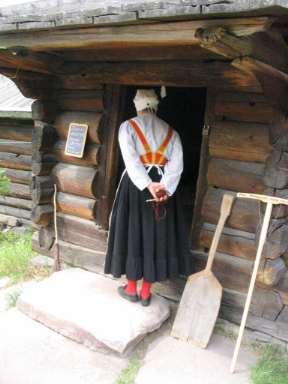
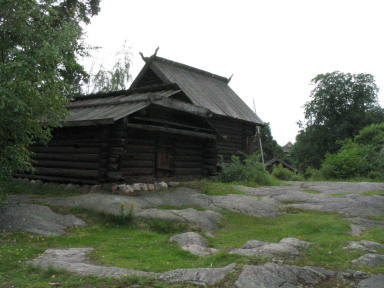
The archipelago that Stockholm is part of has about 24,000
islands. These islands were formed by the inland ice sheet that covered all of
Scandinavian during the ice age. As a result, the rock has a smooth, polished
look to it. I read that the islands of the archipelago are rising out of the sea
at a rate of 40 centimeters every 100 years. There are lots of ferries that
shuttle people from island to island out in the archipelago, so one day we took
a boat out to the island of Grinda, about 1 ½ hours away. The ferry wound
through many islands big and tiny, stopping at various ports to let off or take
on passengers. Some islands were barely big enough for a seagull or two to find
space while others were large and dotted with small summerhouses amidst pine
forest and smoothed rocks.
When we arrived at Grinda, we hopped off along with a bunch
of other people with backpacks, prepared for camping. We found ourselves on an
island with no roads, just a path that should take ½ hour to walk, leading
through the woods to the other side of the island where we would catch another
ferry back. We got some pear cider and a snack (tortilla chips and salsa, can
you believe it?) at a small snack bar at a harbor then got to the dock just as
the ferry was arriving. We made a quick visit to Vaxholm, a small town
recommended by the tourist information, but it was late afternoon and everything
was closed so we waited for the next boat and headed home.
Time to leave Stockholm and go back to the East coast;
Stefan is in a coastal town north of Gothenburg visiting his mom in Kungshamn
where he grew up. He has invited us on a boat cruise through the islands with
some friends of his. It’s a Sunday morning, the sun is shining, and we are all
packed up and Mike starts the bike. Only nothing happens but a sickly little
grunt from the bike. Great. The battery is dead but has enough charge that we
may be able to push start the bike. We take off one of the bags and Mike sits on
the bike paddling along while I push madly from behind, but we can’t get enough
speed so I hike up 4 flights of stairs and try to find the Chilean guy. The door
opens to a woman and I explain in my best Spanish that we need help pushing the
bike because it’s dead. She seems to understand then says, “Do you speak
English? You can talk to me in English…”, noting no doubt that I am not that
fluent in Spanish! The three of us maneuver the bike, minus some of the bags, up
a slight incline then, pushing it, we got it started. I put the keys in the room
since we could now leave, got my jacket on, my helmet on and Mike puts the bike
in gear forgetting that the kickstand is still down. Which kills the engine. (a
built-in safety device that is not that welcome at the moment!) Unable to go
back in the building and unable to raise the Chilean guy, the two of us try
again to push start the bike, which succeeds this time. Jacket back on, helmet
on and… the bike is dead again. Ok, one more time strip, push, put clothes on
again over a now soaked tee-shirt and I manage to get on the bike and we
carefully and cautiously left the parking lot of the hotel, 1 hour later than
planned.
We are now so paranoid that we are anxious for the first
few hundred miles. Is the charging system is working? Will the bike start again
if we turn it off? We don’t know. Mike has to stop for gas and decided to keep
the motor running while pumping gas. At the second gas stop, halfway to our
destination after having driven for a couple hundred miles, we decide to be bold
and shut the engine off. We’re at a gas station with lots of people and if the
bike doesn’t start again we should be able to get help easily. With a twist of
the key the bike starts right us and we give huge sigh of relief. we decided to
take advantage by having a few bites of lunch and use the toilet before taking
off again. As we eat we feel the first few drops of rain.
Riding along the western shore of an enormous lake, we saw
several paper mills and mountains of bark mulch. I just can’t get over the
resemblance to the Oregon coastal hills. The road is starting to get more curvy
and interesting, with small towns on lakes and lots of trees. Unfortunately it
is really starting to pour down rain and we can‘t see much through fogged visors
streaming with rain. (now it really looks like Oregon!) We pulled under some
shelter for a while but the rain showed no signs of waning so we reluctantly
decided to continue. Not wanting to overtax the battery we didn’t plug in our
heated clothing and we were soon pretty cold. It wasn’t too long before we
decided to stop for coffee to warm us up. We found a small store in a town
called Dingle and waited, stiff from cold, behind a crowd of Swedes buying ice
cream cones. We were so wet we were dripping on the floor, puddles forming on
the floor at our feet and Mike’s hands were black from the dye that came off his
sodden leather gloves. We weren’t that far from where we were to meet Stefan and
Jennifer so we gave up and left. Getting very close to the coastline, we started
seeing ice-polished rock formations amongst the trees. The trees gradually
thinned out until we suddenly realized that we were riding along a fjord and the
smell of the sea was in the air. Then we turned into a small village with a
quaint small harbor where we found Stefan and Jennifer and Mom, just finishing
up their dinner.
 Stefan pronounced his dinner at the restaurant not worth
the money so he led us to his mom’s apartment where we stowed our wet leathers
and boots in her “drying room” to dry. The room turned out to literally be as
advertised, a room for drying clothing on lines, with a huge fan blowing warm
air. The warm air felt so good in there, I almost didn’t come out again! But
Stefan’s mom had made us a simple dinner of fried eggs and potatoes fried with
pieces of sausage. I can’t tell you how good that tasted!!
Stefan pronounced his dinner at the restaurant not worth
the money so he led us to his mom’s apartment where we stowed our wet leathers
and boots in her “drying room” to dry. The room turned out to literally be as
advertised, a room for drying clothing on lines, with a huge fan blowing warm
air. The warm air felt so good in there, I almost didn’t come out again! But
Stefan’s mom had made us a simple dinner of fried eggs and potatoes fried with
pieces of sausage. I can’t tell you how good that tasted!!
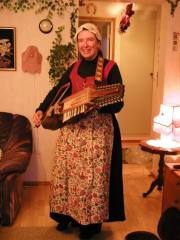
After dinner we visited a bit and although Stefan’s mom
doesn’t speak anything but Swedish, we got along quite well. She showed us the
folk costume from the area that she had hand made years ago and the instrument
called a Nyckelharppa that she also built. About 3 feet long, the instrument
looks like a cross between an autoharp and a violin. It is played with a short
bow and pressing on one of the many buttons on the side of the neck changes the
note by pressing on the string. She dressed me up in her costume and put the
Nyckelharppa in my arms while Jennifer took pictures.
Previous Page
 Next Page